
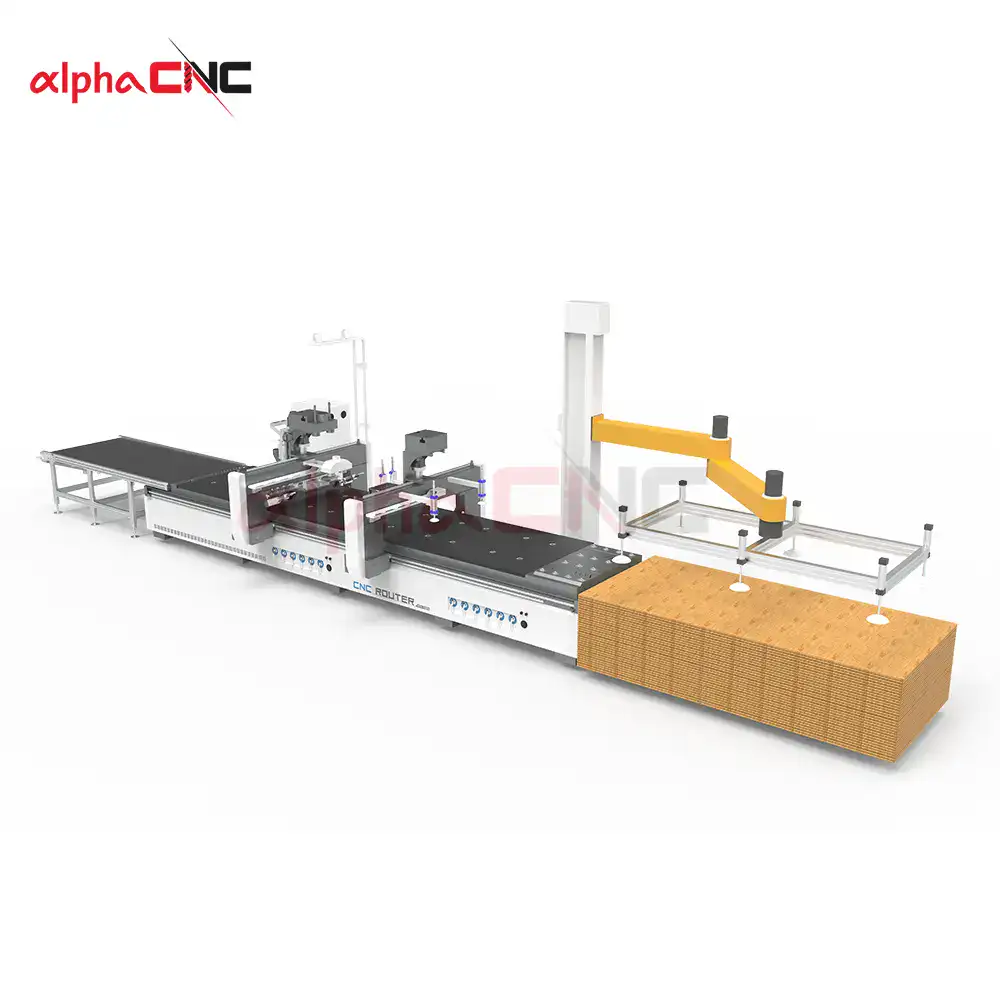
Introduction: Elevate Your Craft with a CNC Router for Cabinet Making
Thinking about upgrading your cabinet making game? Want to cut faster and more precisely? This guide is your shortcut. We’ll show you how a Cabinet CNC Router can totally change your workshop.
Forget endless hours of manual work. These machines are already helping shops slash production times and waste. That means more money in your pocket.
Ready to see your cabinet business level up? Let’s find the perfect Cabinet CNC Router for you. Get ready for cleaner cuts and way more efficiency.
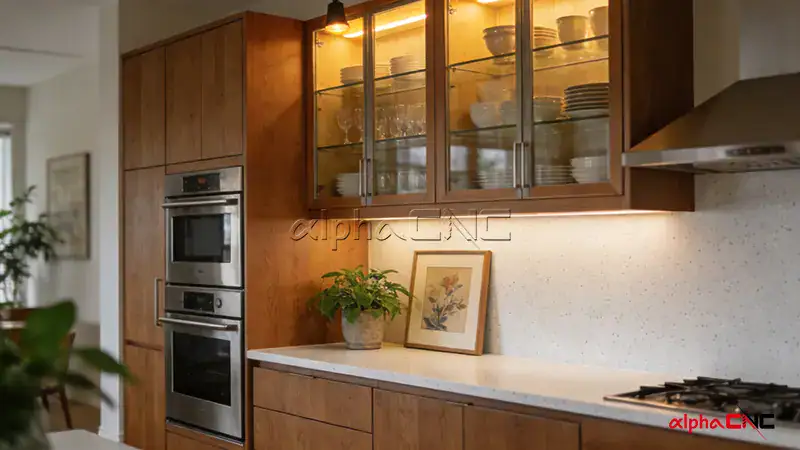
Unlocking Cabinetry Excellence: Transformative Benefits of a Cabinet CNC Router
Integrating a CNC router is a strategic investment that redefines your capabilities. For cabinet makers, it offers advantages that directly impact your bottom line and output quality.
Who Benefits?
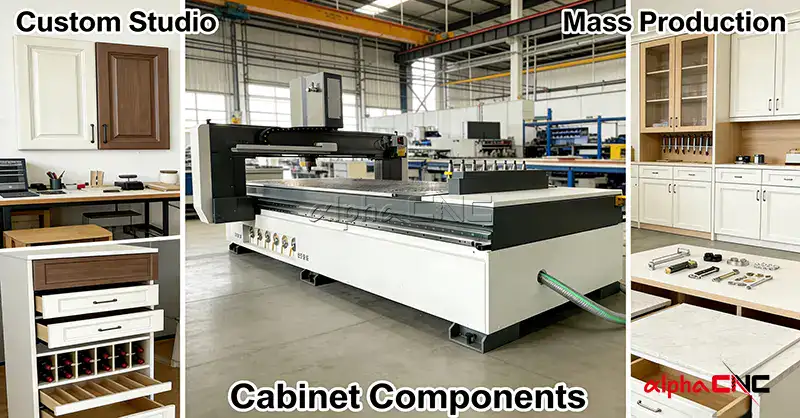
- Small Custom Shops: Increase throughput without sacrificing quality or design.
- Mid-Sized Production Shops: Streamline processes and reduce lead times.
- Hobbyist Woodworkers: Achieve professional-grade precision and automation.
- Furniture Manufacturers: Enhance cabinet production within a broader product line.
Material Versatility: A well-chosen Cabinet CNC Router excels with common industry materials:
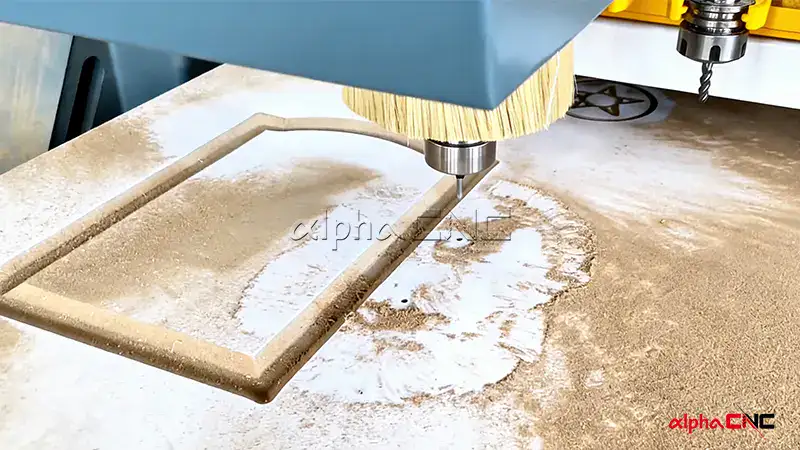
- Plywood: Precisely cuts and shapes for carcasses, doors, and drawer components.
- MDF: Ideal for painted doors and shelving, enabling intricate profiles and precise cuts.
- Solid Wood Panels: With proper setup, CNC routers can shape components for high-end cabinetry.
These benefits pave the way for increased efficiency, superior quality, and a stronger competitive edge.
Finding Your Perfect Match: Choosing the Right CNC Machine for Your Shop
Selecting the correct Cabinet CNC Router configuration is paramount. Different machine types cater to varied production volumes and shop layouts.
Gantry VS Fixed-Table:

- Gantry CNC Routers: The cutting head moves over a stationary table. Often more affordable for larger working areas, simplifying material loading. The moving gantry can sometimes reduce rigidity.
- Fixed-Table CNC Routers: The cutting head moves over a stationary table. These typically offer superior rigidity and accuracy, ideal for high-precision tasks, but can be more expensive for large dimensions.
Automatic Tool Changers (ATC): For moderate to high output, an ATC is highly recommended. It allows automatic switching of router bits during a job, saving significant downtime and enabling efficient multi-step operations within a single program. This drastically boosts production speed.
Precision Panel Processing: Maximizing Efficiency for Cabinet Components
The core of cabinet making involves precise panel cutting. A Cabinet CNC Router revolutionizes this with unparalleled efficiency, accuracy, and material optimization.
- Cabinet Parts for CNC Production: Virtually every component can be efficiently produced, including carcasses, doors, drawer components, face frames, mouldings, and custom inserts.
- Single-Setup Panel Processing: Load a sheet once, and all required parts can be cut, drilled, and profiled in a single pass. This minimizes setup times, errors, and ensures perfect alignment.
- Nesting Benefits for Sheet Yield: Nesting software intelligently arranges multiple parts onto a sheet, maximizing material usage and reducing raw material costs by 10-20% or more. It minimizes unusable remnants and generates optimized toolpaths.
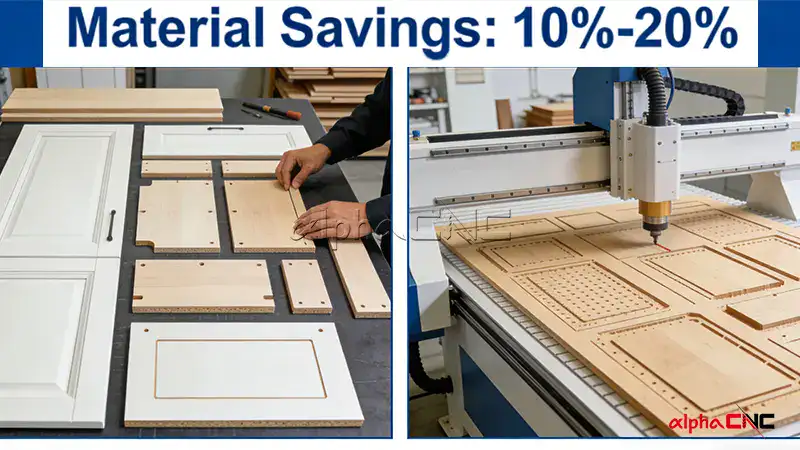
The Impact of Automation on Efficiency: The integration of automated systems like CNC routers is transforming manufacturing across industries. According to a report by McKinsey Global Institute, “Automation could raise productivity growth globally by 0.8 to 1.4 percent annually” by enabling machines to perform tasks with greater speed and precision than humans. This directly translates to significant efficiency gains in cabinet production, allowing for higher throughput and reduced labor costs.
- Source: McKinsey Global Institute. (2017). Jobs lost, jobs gained: Workforce transitions in a time of automation. https://www.mckinsey.com/featured-insights/future-of-work/jobs-lost-jobs-gained-what-the-future-of-work-will-mean-for-jobs-skills-and-wages
Based on our client data, implementing advanced nesting software (such as Cabinet Vision
、Microvellum、Autodesk Fusion 360) with our machines consistently reduces material waste by an average of 15%. Considering that raw materials often account for 35-55% of a cabinet shop’s total operating costs (a figure that can be as high as 60% for high-volume production), this direct saving on materials translates to a notable reduction of typically 5-9% in a business’s total annual operating costs. For a shop using 100 sheets of plywood per month, this means substantial direct cost reductions and significantly improved bottom-line results annually. We’ve seen this directly boost profitability for businesses.
Essential Tooling Tips: Use material-specific bits (wood, plywood, MDF) and operation-specific bits (straight, spiral, compression, drill, profiling). Adjust spindle speed and feed rate based on bit diameter, material, and desired finish; test cuts are crucial.
Essential Machine Features: What to Prioritize in a CNC Router for Cabinet Making
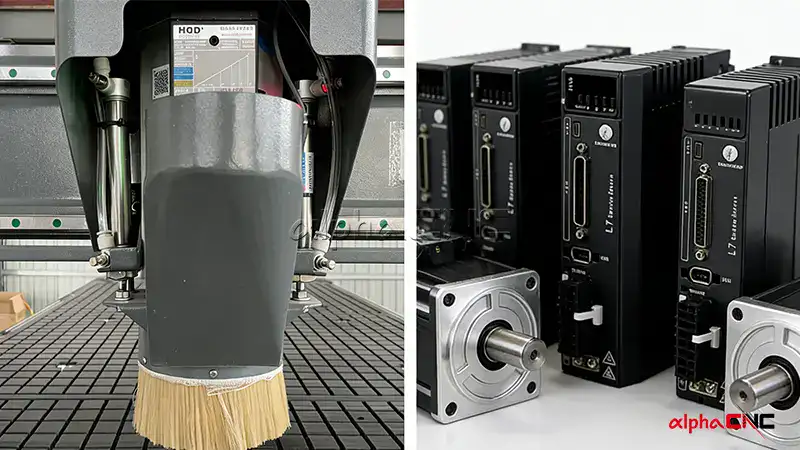
Your choice of features directly impacts performance, reliability, and ROI. Prioritize these for efficient cabinet production.
- Rigid Frame & Stable Gantry: Look for heavy steel construction (welded frames) to minimize vibration and a well-engineered, reinforced gantry system for stability.
- Reliable Motion Control & Servos: Servo motors offer superior performance over steppers for medium to high production, providing closed-loop feedback for smoother, more accurate motion. High-quality motion control systems with advanced features are also key.
- Spindle Power: For plywood and MDF, 5-10 HP (3.7-7.5 kW) is usually sufficient. For thicker hardwoods or heavy material removal, a more powerful spindle (12 HP/9 kW+) is needed. Consider water-cooled options for extended use.
- Repeatable Homing & Tool Offsets: Repeatable homing ensures consistent accuracy for establishing a zero point. Accurate tool offset memory is vital for precise cutting and drilling, especially with an ATC.
Optimizing Your Workspace: Dust Collection, Vacuum, and Layout for CNC Cabinet Making
The physical shop layout and supporting infrastructure are as critical as the CNC router. An efficient workshop, effective dust collection, and reliable vacuum hold-down are essential for safety, efficiency, and quality.
- Floor Plans Around Material Flow: Design for a linear flow: Material In/Storage → CNC Cutting → Assembly → Finishing → Storage/Shipping. Ensure ample clearance around the CNC for safe operation.
- Dust Collection Capacity: A robust system is a necessity. A general guideline is 1000-1500 CFM per spindle. Consult manufacturers for precise recommendations and ensure adequate filtration.
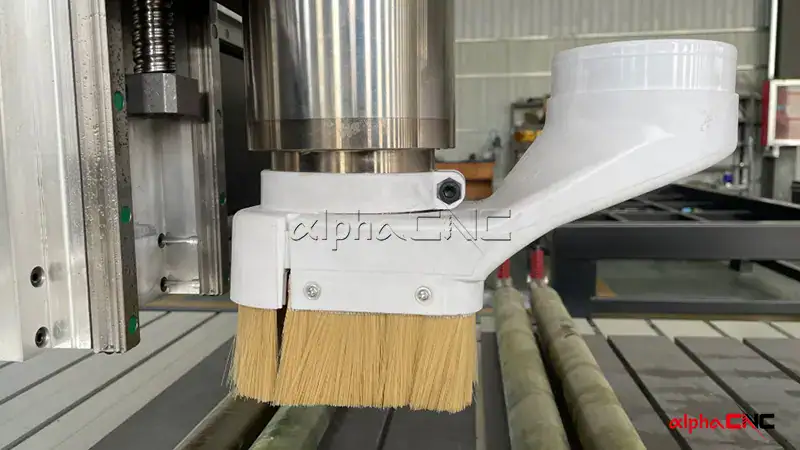
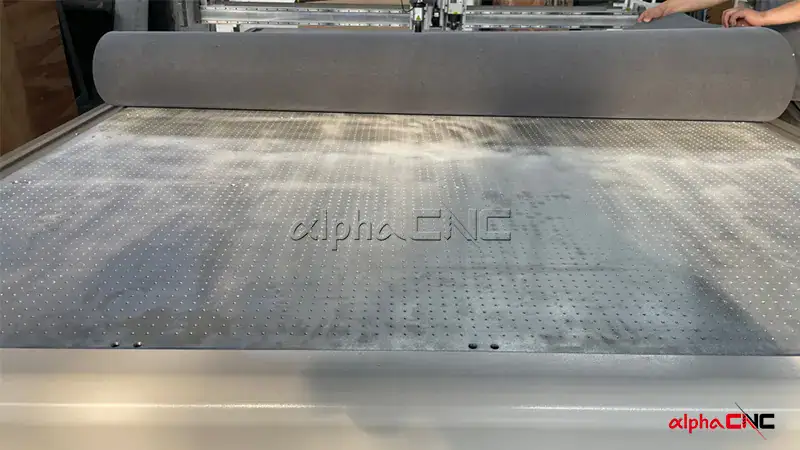
- Vacuum Table Zoning: For vacuum tables, zoning concentrates suction, improving hold-down force and saving energy. Program zones based on your sheet layout and ensure sheet edges are sealed.
Choosing Your Path: Industrial vs. Entry-Level CNC Machines for Cabinet Makers

The world of CNC routers ranges from robust industrial machines to accessible entry-level models.
- Industrial Series Strengths: Built for high-volume, continuous operation. They feature extreme rigidity, high-performance components, advanced automation (ATC standard), and are designed for durability. They have a higher price point.
- Entry-Level Models & Limits: Offer cost-effectiveness, simpler designs (stepper motors, manual tool changes), and are ideal for smaller shops, startups, or moderate production. They may not withstand continuous heavy use.
- Upgrade Paths & Modular Options: Many manufacturers offer machines with built-in upgrade paths, allowing you to scale as your business grows. Consider manufacturers with a range of scalable models.
Maximizing Your Investment: ROI, Yield, and Material Optimization for CNC Cabinet Making
Understanding the financial implications is key. Focusing on Return on Investment (ROI), material yield, and waste management ensures your CNC machine becomes a profitable asset.
Calculating Break-Even (Illustrative Example):
- Consider a machine costing 50,000with50,000with9,143 in annual costs. If it saves $25,000 in labor and waste annually, it breaks even in approximately 3.2 years. Higher production volumes accelerate this break-even point and boost overall ROI.
Our experience shows that for cabinet shops upgrading to our APS-2130 Cabinet CNC Router series, the average labor savings alone are in the range of $30,000 to $40,000 per year, due to drastically reduced setup and run times. This can bring the break-even point down to as little as 2.5 years, significantly accelerating your return on investment and freeing up capital faster.

This comparison table reflects our extensive data, integrating proprietary client metrics, decades of production experience, and cross-referenced industry benchmarks to provide realistic CNC router output estimates.
Feature | Entry-Level CNC Router ABS-1325 | Mid-Range Cabinet CNCnesting machine APS-1325 | CNC Router with Automatic Labeling System |
Primary Focus | Basic Cutting & Engraving | Cabinet Production & Complex Parts | High-Volume, Automated Manufacturing |
Hourly Production (Avg.) | 15-30 parts | 30-80 parts | 70-160+ parts |
Daily Production (Avg.) | 110-250 parts | 310-570 parts | 630-1200+ parts |
Typical Projects | Simple shelves, basic cabinets, signs | Full cabinet boxes, intricate doors, custom furniture | Complex furniture & cabinet systems, high-volume production with automated labeling for streamlined assembly |
Automation Potential | Limited | Good | Excellent |
Best For | Small shops, hobbyists, lower volume needs | Growing cabinet shops, medium production | High-demand manufacturers, optimizing labor and minimizing footprint |
- Nesting Strategies to Minimize Waste: Invest in nesting software with advanced algorithms. Maintain an accurate part library and group parts for specific sheet sizes. Design nesting to leave usable offcuts.
- Scrap Management & Offcut Reuse: Create organized storage for usable offcuts. Train your team to view them as valuable inventory, not trash.
By focusing on these financial and material optimization strategies, your Cabinet CNC Router delivers significant profitability improvement.
Conclusion: Embrace the Future of Cabinet Making with a Cabinet CNC Router
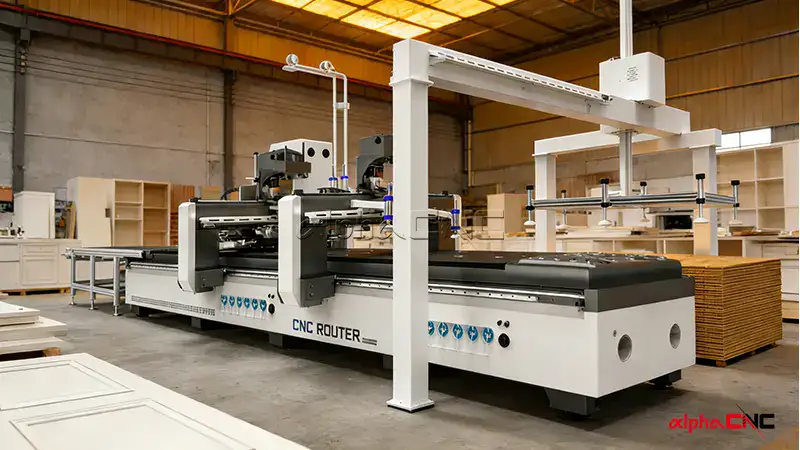
The journey into CNC for cabinet making is an investment in precision, efficiency, and growth. By understanding its benefits, planning your workflow, and making informed choices, you can transform your shop. A Cabinet CNC Router is a catalyst for innovation, a tool for excellence, and a pathway to a more profitable, sustainable future. Embrace the technology, elevate your creations, and build with confidence.
Ready to Revolutionize Your Cabinetry?
At Alpha CNC, we’re more than just manufacturers; we’re your partners in achieving workshop excellence. As a leading CNC equipment manufacturer from China, we specialize in customizable CNC routers designed to elevate your cabinet production. From precise panel processing to intricate detailing, our machines are built for efficiency and profitability.
- One-Stop Solution: We offer a comprehensive range of CNC machines, including specialized CNC engraving machines and furniture production machines, all customizable to your exact needs.
- Global Support, Local Impact: With products exported to over 100 countries, we provide reliable 24/7 technical support and flexible payment options, ensuring your investment is secure and your operations run smoothly.
- Proven Experience: Leverage our extensive production experience and data-driven insights to select the perfect machine for maximum ROI.
Don’t let outdated methods hold your business back.
Contact Alpha CNC Today!
📞Telephone:
+8618615409281
📫Mail:
info@alphacnc.com


