
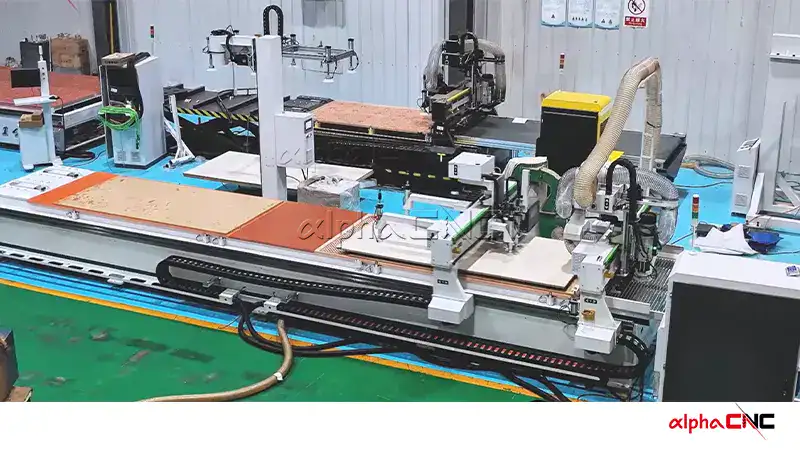
For a start-up panel furniture manufacturer, the selection and planning of furniture manufacturing equipment is crucial, as it can affect the initial capital investment, production efficiency, and later profitability. This article is mainly based on the ATC nested line machine, helping you with detailed planning of equipment, budget, and factory.
1. 3-Tier Furniture Manufacturing Equipment Plans: Low Budget Furniture Factory Setup Cost
Alpha CNC provides three complete and practical equipment configuration solutions for panel furniture manufacturers. Tailored according to different factory sizes, production capacities, and budgets. Our designated plan prioritizes the use of ATC nested centers as core equipment to meet the needs of different start-up panel furniture factories.
1.1 Small Startup Solution (suitable for 50–70 Boards/Day)
Many emerging panel furniture manufacturers are willing to start from small cabinet factories due to their low initial budget, in order to reduce investment costs. If you want to create a low budget furniture production factory, this small production line can meet your daily cabinet panel production needs.
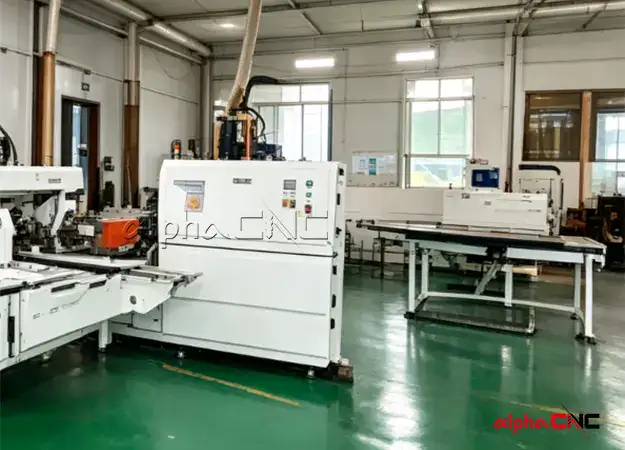
Applicable scenarios: This solution is very suitable for local small orders, home decoration scattered orders, unstable orders, and start-up panel furniture factories with limited funds. Only a workshop of 260-350 square meters is needed, equipped with 6-8 staff members. Cabinet doors can be outsourced to reduce initial investment.
Core furniture manufacturing setup equipment
- 12 tool standard ATC CNC nesting center ($8000-10000): This machine is equipped with a 4×8-foot worktable, a 9KW air-cooled spindle, a 12 station tool magazine, a double-layer vacuum worktable, and a 7.5KW vacuum pump. This ATC machine can independently complete sheet cutting, backplate slotting, 3-in-1 connector hole drilling, and simple door profiling, fully compatible with invisible accessory production.
- Fully automatic pre milling tracking edge banding machine ($11000-14000): Equipped with single EVA can, pre milling, end trimming, rough/fine machining, R-scraping, edge scraping, cleaning and polishing functions. It can stably seal narrow and curved boards to meet mid-range home decoration order standards.
- Laser scanning side hole drilling machine ($3,200–$4,000): It is an automated drilling equipment. For boards that have already been cut and have vertical holes, the laser scans the existing hole positions to automatically calculate and locate the punching positions. Realize precise and efficient processing.
- Auxiliary woodworking machinery & systems: 16KW screw air compressor with air storage tank and freeze dryer, central pulse dust collector, hinge drilling machine, curve edge banding machine, material rack and polishing tool. It also supports professional cabinet design software and one click program output.
- Staff allocation: 1 person is required for nesting, 2 people are required for edge sealing, 2 people are required for drilling and polishing, and 1-2 people are required for packaging and transportation.
- Pros & cons: Equipped with ATC tool changing configuration, high degree of automation; The basic processing technology is relatively complete, and the investment return is fast. But the production capacity is limited, and the back of the board needs to be manually flipped.
- If you need efficient assembly line production or customized panels with complex processing techniques, it is recommended to upgrade to a six sided drill, which can achieve higher output.
1.2 Why ATC CNC nesting Machine Replaces 4-process CNC Router In Furniture Factory Equipment Planning
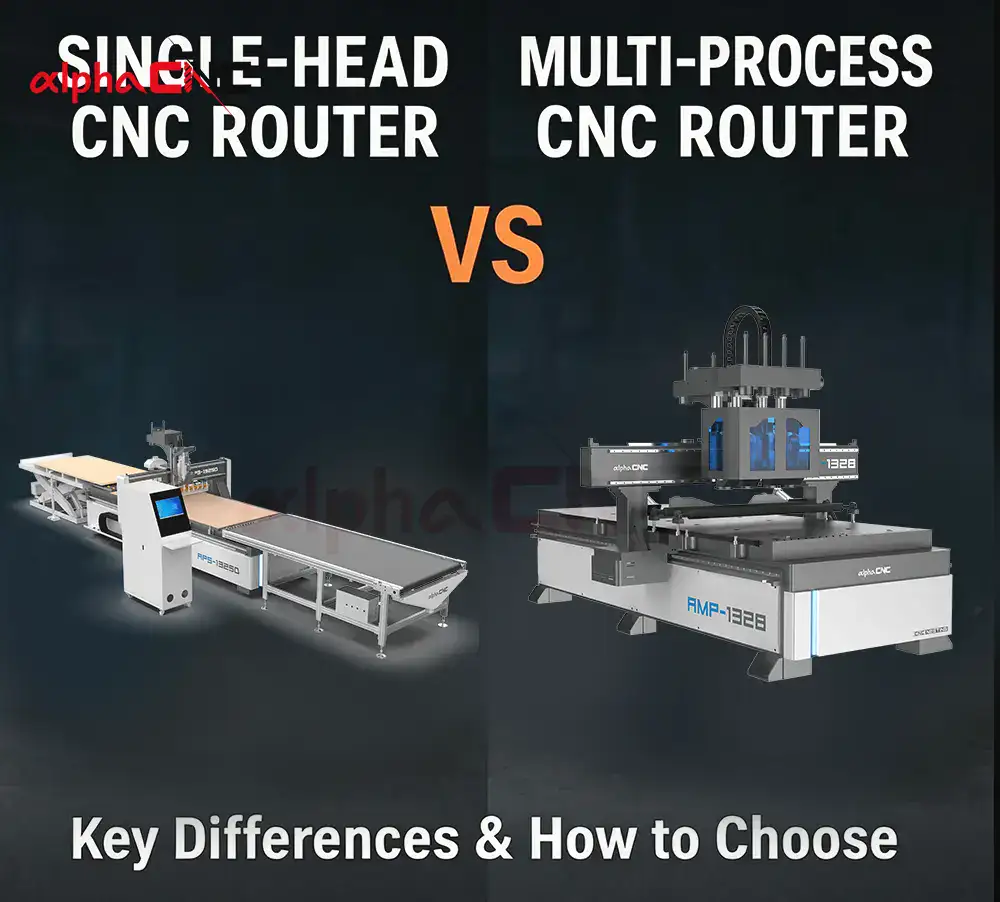
Many mechanical suppliers believe that 4-process CNC routers have a low threshold as entry-level equipment, so they are still promoting them to start-up furniture factories. We suggest that start-up manufacturers choose ATC CNC nesting machines.
In most cases, the price difference between the two devices is not significant. Apart from upgrading the device model, the price difference between the two may even be around $500. Although prices fluctuate, ATC CNC nesting machines can provide higher practical value for long-term furniture manufacturing equipment investment at the same price point.
Most standard ATC nesting units are equipped with 8, 12, or 16 tool magazines and dedicated air-cooled spindles. They completed the complete production process in one workflow, including sheet cutting, slotting, precise drilling, and customized profile forming.
In contrast, traditional multi process CNC engraving and milling machines (such as 4-process) have significant limitations in terms of tool quantity and machining performance. They are unable to handle complex door contours, which limits the factory’s ability to accept high-value customized orders.
Switching to ATC CNC nesting machines can help new factories avoid repeated equipment upgrades and effectively reduce long-term woodworking production and operation costs.
1.3 Standard Production Solution (100–140 Boards/Day | Most Recommended)
Applicable scenario: The best choice for 80% of new panel furniture factories. This plan is suitable for manufacturers who have bulk production orders and can independently produce cabinet door panels. The layout of this type of machine requires a workshop of 450-600 square meters and 9-12 workers.
Core furniture manufacturing equipment
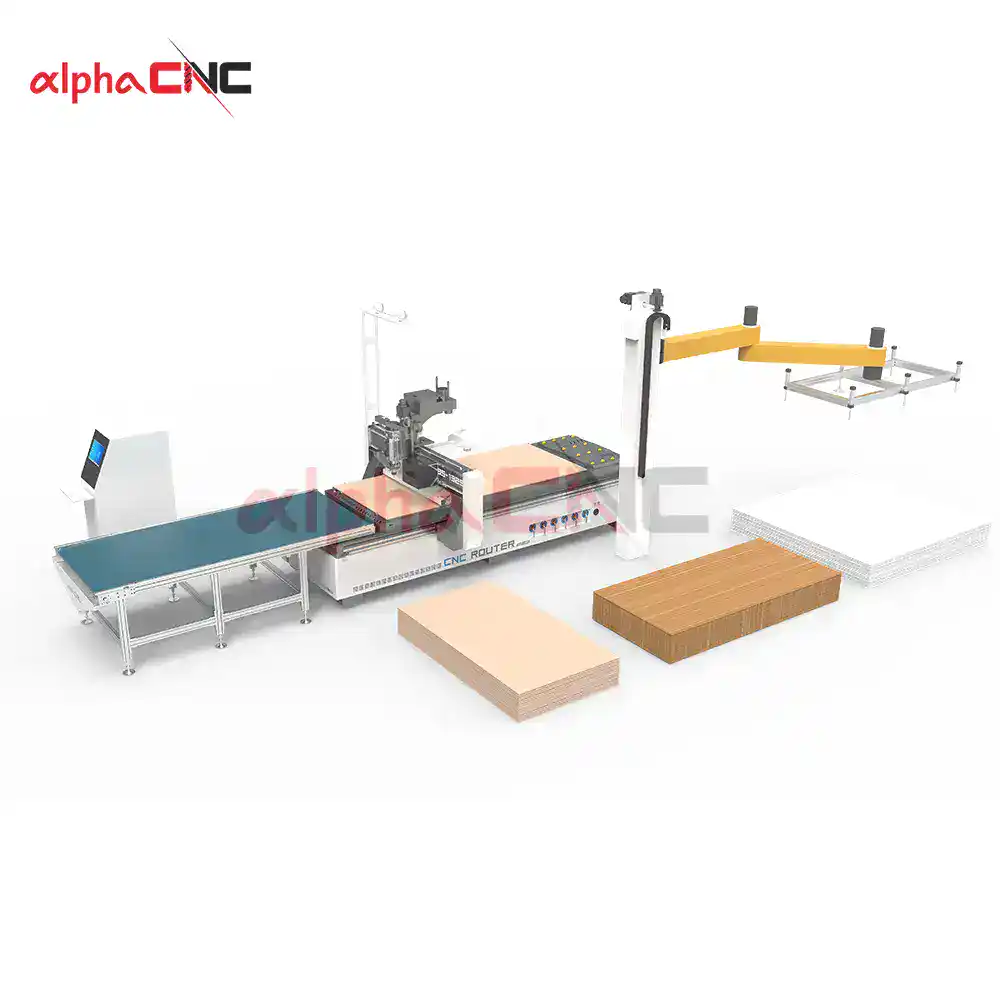
- High-end automatic labeling ATC CNC nesting center ($11000-14000): Equipped with 16 cutting tools, automatic labeling function, and high-power vacuum suction. It can reduce human errors by 90%. Support cutting and carving complex door contours without the need for frequent tool adjustments, reducing labor costs.
The quantity of cutting tools can be customized according to your specific processing needs.
- Heavy-duty dual-glue-pot tracking edge banding machine ($15,000–$25,000): Usually equipped with a full set of edge sealing functions, covering the entire process from pre-treatment to final polishing, supporting switchable EVA and PUR hot melt adhesives. Including double glue tank system, pre milling device, trimming unit, etc. It can be equipped with a servo control system to achieve more precise adjustments. Very suitable for customized orders of mid to high end PET door panels.
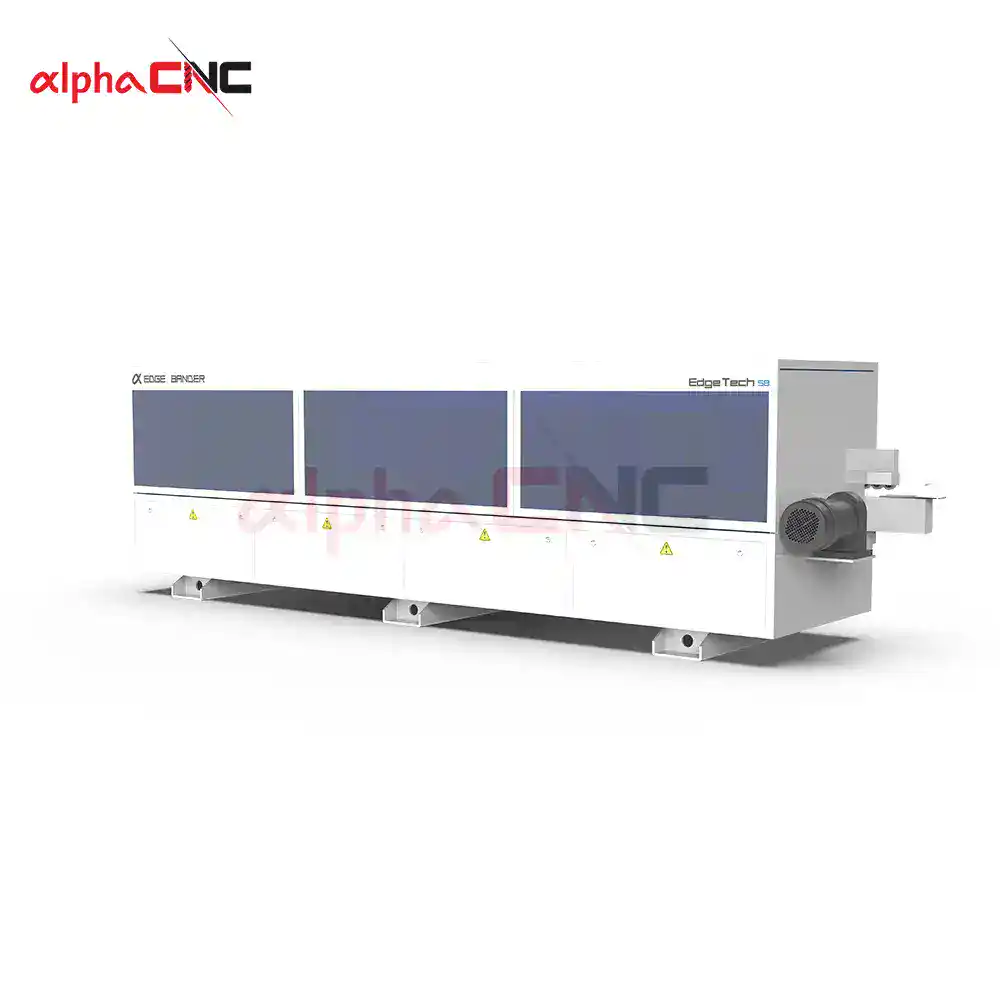
- Full-automatic six-sided boring machine ($15,000–$18,000): This machine can be clamped in one go and automatically complete all hole processing on the six sides of the board, including drilling, slotting, and simple milling.
It is particularly suitable for customized furniture, cabinets, office furniture, and other production scenarios that require complex drilling and flexible batch production. Only one operator is needed to operate, saving labor costs and fully complying with ATC nested production efficiency.
- Auxiliary supporting equipment: 4×9ft independent door production vacuum film compressor, 22KW high-power air compressor, large central pulse dust collector, dual station hinge drill, broadband sanding machine, automatic packaging assembly line.
- Staff allocation: Two people are allocated for nesting, two for edge sealing, one for hexagonal drilling, three for door polishing and assembly, and two for packaging.
- Core advantages: The exquisite balance of efficiency, cost, and quality has been achieved in the production of standard panel furniture, making it a reliable choice for start-up small and medium-sized panel furniture factories to upgrade to standardized automation. The entire process covers home decoration orders and high-end customization. Specialized equipment is efficient and stable, significantly reducing overall costs.
1.4 High-end Automatic Production Solution (200+ Boards/Day)
Applicable scenario: This solution serves the large-scale and high standard production needs. It can meet the main production lines of large furniture manufacturing enterprises and achieve stable and mass production. This equipment solution requires a factory area of over 800 square meters to facilitate automated operation and sorting and packaging of the production line. It is not recommended to invest in unstable start-up small factories.
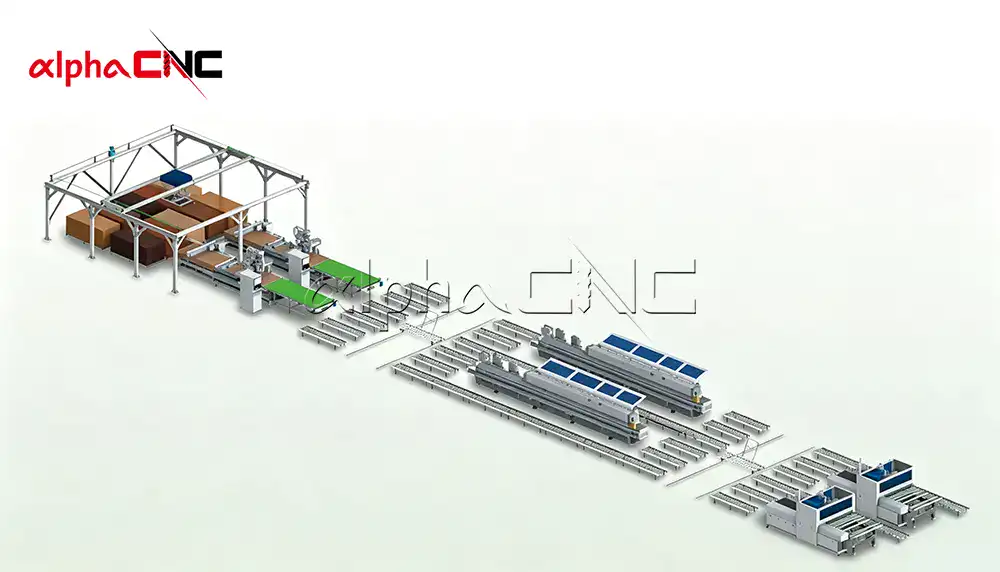
Automatic Core furniture manufacturing equipment
- Nesting unit ($48,000–$58,000): Dual station ATC CNC nesting machine, equipped with automatic loading and unloading elevators and roller conveyor lines, achieving double production efficiency with dual stations; Single person supervision can achieve automatic sheet stacking, labeling, and processing.
- Edge banding unit ($30,000–$46,000): Heavy duty PUR laser edge banding machine with zero-glue-line effect, suitable for high-end PET and matte door panels. Equipped with edge sealing rotation line to eliminate manual loading and unloading labor.
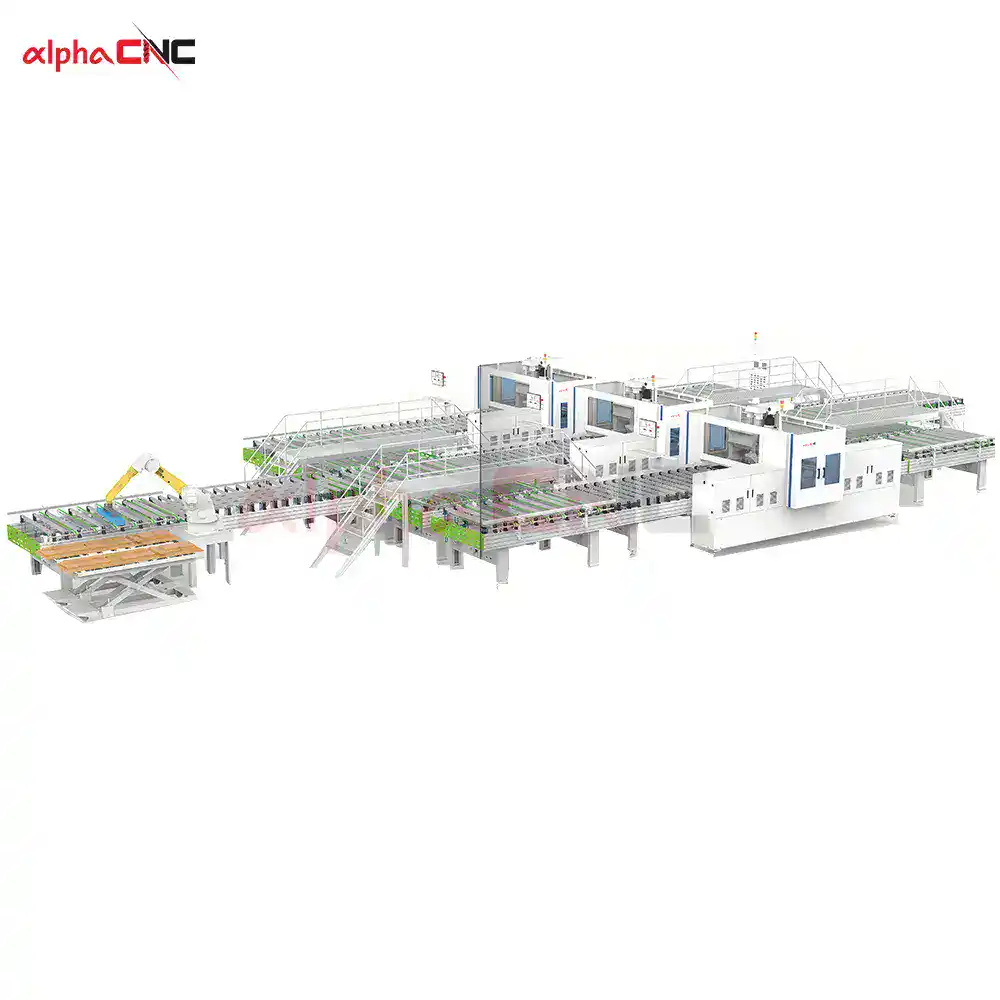
- Drilling unit ($28,000–$34,000): Double drilling package with six sided drilling machine, equipped with automatic board transportation, can achieve from nesting to drilling without supervision. The number of drill packs and ATC can be optionally selected.
- Complete supporting systems: Including a full door production line, an integrated large-scale negative pressure film press, and an aluminum profile cutting machine; Intelligent scanning sorting system and sheet storage area; Provide environmental protection and power guarantee, integrate heavy-duty dust removal equipment to ensure compliance with production environment.
- Core advantages: Ultra high automation, minimal dependence on labor, and stable batch delivery. If a startup company does not have long-term stable large orders, it is not recommended to use this solution.
| Line Type | Daily Output | Workshop Area | On-site Staff | Total Investment Range | Payback Period | Suitable Orders | Pros & Cons |
| Small-Scale Startup Line | 50–70 panels/day | 260-350 ㎡ | 6–8 workers | $22k–$28k (core machinery); $40k–$60k (full startup) | 12–18 months | Small-batch custom cabinets, wardrobes, unstable startup orders | Low upfront cost, high flexibility; Lower efficiency, limited production capacity |
| Medium-Scale Custom Line | 100–140 panels/day | 450-600 ㎡ | 10–12 workers | $55k–$75k (core machinery); $90k–$120k (full setup) | 18–24 months | Stable-volume whole-house furniture, mid-sized retail cabinet orders | Balanced cost & efficiency, supports PET/laminate panels; Higher investment, requires fixed order volume |
| High-Automation Large-Scale Line | 200+ panels/day | 800+ ㎡ | 8–10 workers | $120k–$200k (core line); $200k–$350k (full automatic setup) | 24–36 months | High-volume engineering projects, export furniture, batch production | Ultra-high efficiency, 60% labor reduction, consistent quality; High initial investment, needs professional operation |
2. Optimized Workshop Layout & Factory Planning For Panel Furniture Production
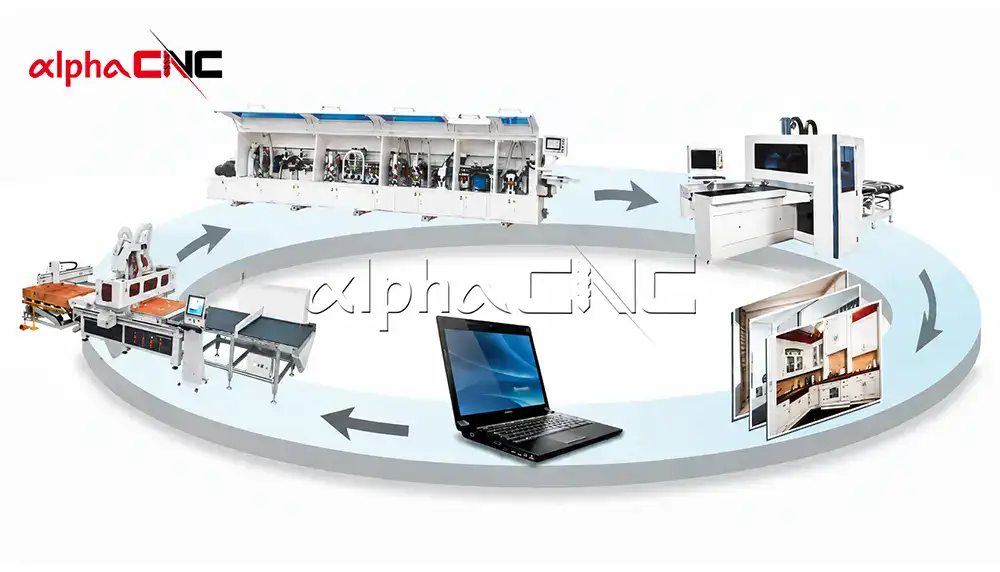
Reasonable factory planning should be centered around the process flow, optimizing the layout of the entire process from raw materials to finished product packaging, in order to improve production and operational efficiency
- Standard process flow
Raw material storage → ATC CNC cutting (nested processing) → Edge banding → Six sided drilling → Door panel processing → Polishing and assembly → Finished product packaging and storage. The production line needs to be set up in this order to ensure one-way flow of materials.
- Basic guarantee and environmental protection
Air compressors and dust removal equipment must be isolated and placed to reduce noise and dust; The total power of the production line needs to reach 160KW, and the net height of the workshop should not be less than 4 meters.
- Export and customization adaptation
For some high-end overseas orders, targeted services are provided in different regions.
For high-end hotel projects in the Middle East, panel furniture needs to adapt to dry and temperature sensitive climates, and imported particleboard with high moisture resistance is selected for the panels.
The North American market needs a quick response because most of its orders have tight delivery times. All equipment shipped to the United States has passed UL safety compliance testing, and all equipment supplied to Canada meets CSA certification standards. In customized solutions, the production line needs to integrate automation functions. It can reduce manual intervention and machine adjustment time.
For specific markets such as Brazil, we offer localized customization across multiple dimensions, including voltage (220v 3-phase 60Hz or 380v 3-phase 60Hz), dust removal system, and overall machine specifications to adapt to the local factory environment. More importantly, all woodworking machinery complies with the latest updated NR-12 regulatory standards to enhance safety protection.
3. Phased Procurement Strategy To Reduce Startup Furniture Equipment Manufacturers Investment
The core of the phased strategy for new manufacturers is to break down a one-time huge investment into multiple phases, reduce start-up costs of cabinet factories pressure, and avoid blind investment risks.
The specific implementation strategy can be divided into three stages
- Early Stages: In the initial stage, focus on core processing equipment: prioritize investing in core furniture manufacturing equipment, such as automatic tool change nesting router, edge banding machines, and drilling machines. For complex hole positions that cannot be processed by drilling, external processing can be used. When the order volume is not large, this model is more economical and the process is simplified.
- After the order volume stabilizes: your order volume or board complexity may increase, leading to efficiency bottlenecks in processes such as drilling and polishing. At this point, specialized automation equipment such as six sided drills will be purchased for expansion.
- Optimization and upgrade stage: When the production volume exceeds the expected value, automated production can be expanded, automatic conveying and sorting equipment can be added, and a fully automatic continuous production line can be realized.
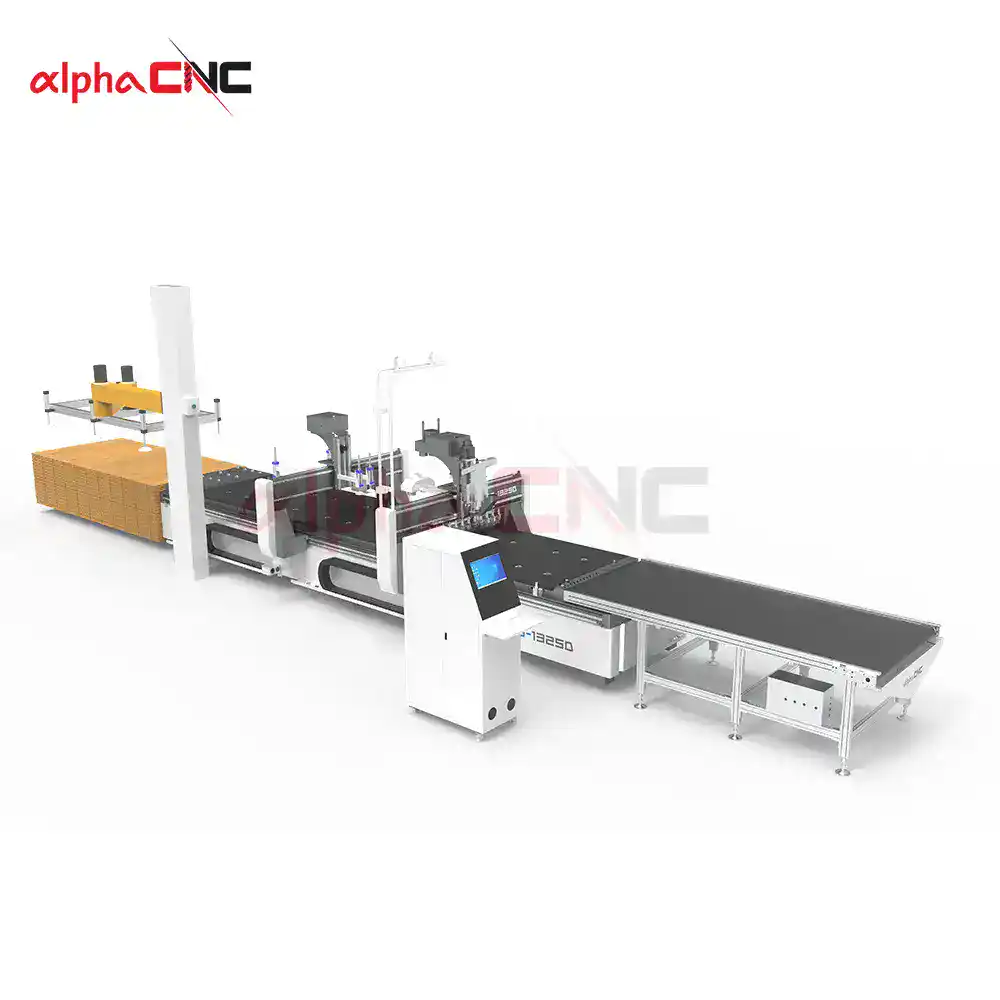
Tip: This requires you to reserve equipment interfaces, space, and basic power in the early planning stage. Ensure that subsequent equipment can be easily installed upon purchase to avoid waste.
4. Essential Supporting Auxiliary Panel Furniture Woodworking Machinery & Systems
In addition to the main process equipment (such as cutting, edge sealing, drilling equipment), auxiliary equipment is configured to ensure the efficient, safe, and precise operation of the production line in the panel furniture factory. They connect various processes in the production line while ensuring quality and safety.
The core components usually include:
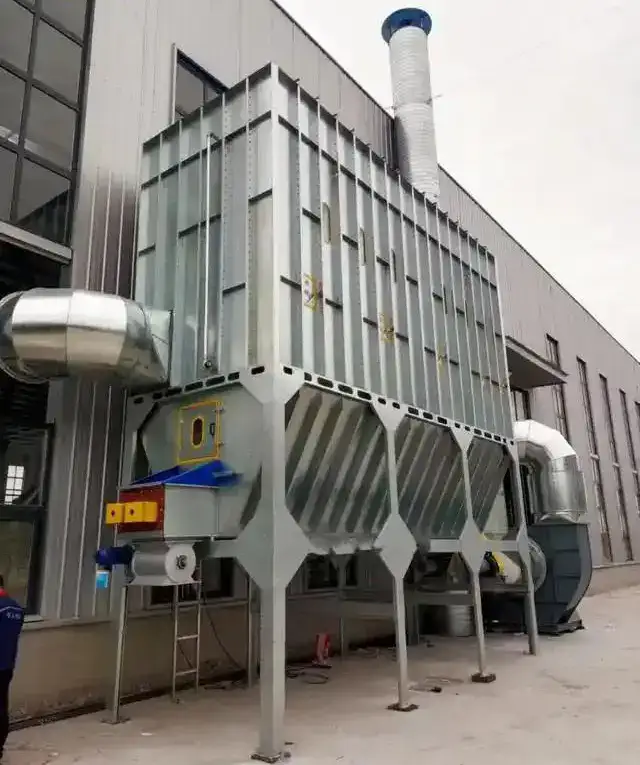
- Dust removal and air control system: Collecting a large amount of dust generated during sawing, milling, and other processes through a central dust collector, pipeline, and suction port. Ensure the health of workers, equipment accuracy and production safety, and meet environmental compliance requirements. For example, panel furniture factories commonly use bag filters with pulse dust cleaning function.
- Material handling system: ensuring smooth production line. Includes roller table, vacuum suction cup hanger (can be operated by a single person, with a load capacity of up to 200kg), and buffer rack, etc. Used for smooth transfer of boards, safe loading of large boards, and orderly storage of work in progress, reducing manual injury and cost consumption.
5、Frequently Asked Questions About Startup Furniture Equipment Planning
Q1: How much does it cost to start a small panel furniture factory?
For a small panel furniture factory layout that processes 50-70 panels per day, the cost of core machinery is $20000-28000. The entire production line includes an ATC nesting machine, edge banding machine, and auxiliary equipment. Increase workshop rent, raw material inventory, dust removal, power supply settings, and reserve salary for 6-8 employees. If some cabinet door processing is outsourced to reduce upfront investment, the initial total budget for starting a small panel furniture factory may be around $40000 to $60000.
Q2: Which equipment solution is most suitable for new panel furniture factories?
There is no absolute best equipment solution. You need to choose based on your factory size and target market. For most start-up panel furniture factories or small and medium-sized enterprises, phased investment is a low-risk and more reliable choice. It can balance start-up cabinet factory setup costs and production capacity, and can basically cover most types of orders.
Q3: Is a six sided drilling machine necessary for panel furniture production lines?
Yes, for factories with stable orders. Six sided drilling completes all hole processing in one go, eliminating the need for manual flipping of side holes, greatly reducing labor costs and error rates. Perfectly matched with the production efficiency of the ATC nesting machine.
Q4: What basic layout conditions are required for a standard furniture manufacturing factory?
Workshop has an area of 450 to 600 square meters, a height of over 4 meters, a total power configuration of 160KW, and complete dust removal and gas supply systems. Reasonable workshop layout and standardized equipment configuration can ensure stable and efficient production.
Q5: Can startup factories outsource door panels to save costs?
Early production is completely feasible. Small factories can outsource molding and painting doors to reduce the initial investment in furniture manufacturing equipment, and increase the use of film presses for independent door production after stable orders in the later stage.
Q6: Why is a professional dust collection system indispensable?
The high-speed operation of ATC CNC nesting machine and edge banding machine will produce a large amount of sawdust. Dust intrusion into equipment can accelerate wear and blockage, leading to malfunctions. The dust removal system can protect equipment, reduce unplanned shutdowns, equipment guide rail wear, and extend the service life of all woodworking machinery.
Final Thoughts
The above three sets of plans are not only equipment lists, but also a dynamic production system that enables start-up panel furniture factories to synchronize their production capacity and order growth. It can help your cabinet factory move from “initial survival” to “benign operation”.
Alpha CNC provides comprehensive furniture manufacturing equipment and free professional factory planning services for start-up panel furniture factories. If you still don’t know how to choose, tell us your planned budget and our professional design team will help you establish an efficient production factory.
📞:+8618615409281


