
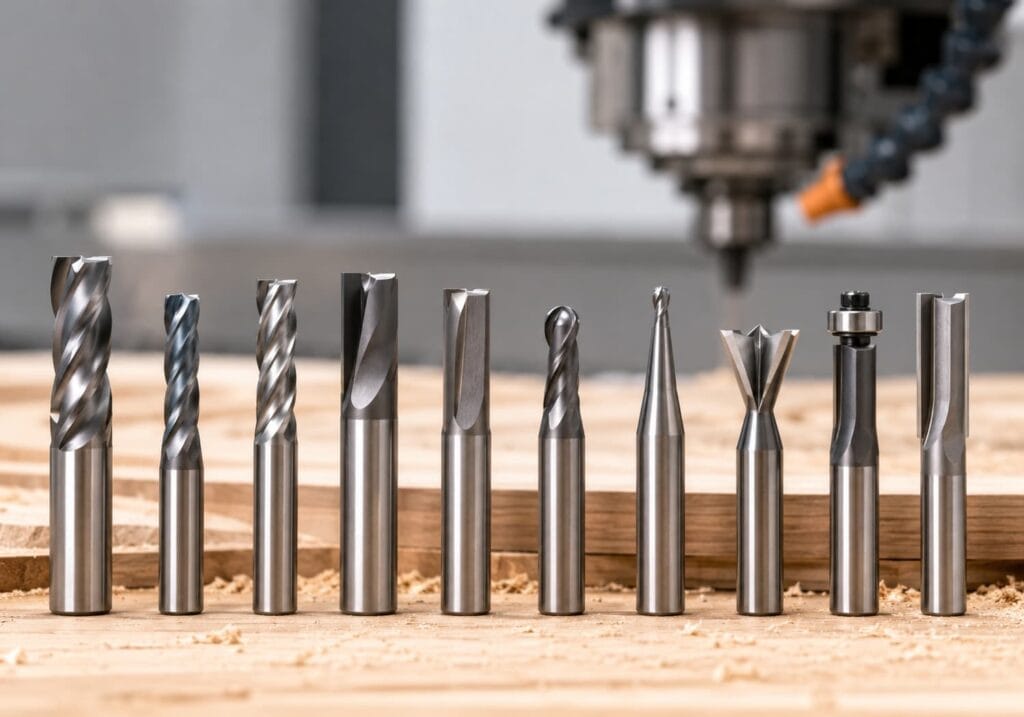
The machining effect of a CNC router depends not only on the machine itself, but also on the choice of cutting tools. Different CNC router bits are suitable for different materials and machining methods, so understanding common tool types and their uses can help you choose the right tool, improve machining efficiency, and extend tool life.
1. What is a CNC Router Bit?

CNC bits are rotary cutting tools installed on the CNC router spindle, also known as CNC router tools, CNC bits for CNC machines, and CNC engraving bits.
What Can CNC Router Bits Do?

Different types of CNC bits can undertake different machining tasks, and common ones include:
- Cutting: Cutting a sheet or workpiece into a specified contour;
- Pocketing: Removing material from a specified area;
- Grooving/slotting: Machining grooves or slots;
- Engraving: Processing text, patterns, and shallow details;
- 3D Carving: Processing three-dimensional shapes such as curved surfaces and reliefs.
2. CNC Router Bit Types and Their Applications
There are many types of CNC router bits, and the structure of different router bits determines their suitability.
Upcut Bit

During cutting, it removes chips upward, so it has good chip evacuation performance. Upcut bits are suitable for machining wood, MDF, plywood, and plastic, especially for deep cutting, grooving, and machining that requires fast chip removal. An upcut bit generally helps produce a cleaner bottom edge.
However, due to the upward cutting force generated by the tool, burrs or chipping may appear on the surface of the workpiece or the edge of the incision. If the workpiece is not firmly fixed, the upward cutting force may also cause the workpiece to move. During processing, it is necessary to ensure stable clamping of the workpiece.
Downcut Bit

The spiral structure of the downcut bit will bring cutting force and debris downwards into the cutting groove, thus helping to reduce burrs and chipping on the surface of the workpiece, suitable for thin plates and machining tasks with high requirements for surface processing quality.
Downcut bits push chips into the cutting area and generally provide a cleaner top edge, but chip evacuation can be limited in deep cuts. Especially in deep grooves or deep cutting, chips may accumulate in the cutting area. If the chip removal conditions are insufficient, chip accumulation will increase friction and heat, affect machining efficiency, and may shorten tool life.
Compression Bit

A Compression bit is a tool that combines the characteristics of upcut and downcut. The blade adopts the opposite spiral direction, with the part near the tip usually being an upcut and the part near the handle usually being a downcut. This combination method can balance the vertical forces generated during the cutting process, thereby reducing burrs and chipping on the upper and lower surfaces of the workpiece.

Compression bits are particularly suitable for through-cutting plywood, MDF, and other laminated or multilayer sheet goods when clean top and bottom edges are required.
Straight Flute Bit

A straight-flute bit does not actively lift or push chips like an upcut or downcut bit, so chip evacuation depends more on the cutting conditions and dust extraction. It is especially suitable for conventional machining tasks with shallow cutting depths and no special requirements for the edge quality of the top and bottom surfaces.
During machining, it is necessary to control the cutting depth and feed rate, and ensure that the cutting area has good chip evacuation conditions.
Ball Nose Bit

A Ball-nose bit, also known as a round-nose bit, is often used to process wood, plastic, foam, and some non-ferrous metals. It can also be used to make wood carvings, three-dimensional reliefs, models, and workpieces with curved surfaces, especially suitable for processing tasks requiring smooth transitions and detailed representation.
However, due to the fact that the tip of a ball cutter is not flat, in order to achieve a finer curved surface effect, it is usually necessary to choose the appropriate tool diameter and cutting parameters based on the specific material.
Tapered Ball Nose Bit

The body of the tapered ball nose bit gradually narrows from the handle to the tip, and the tip has a circular arc structure. It is suitable for machining three-dimensional surfaces and can maintain good tool rigidity in deeper 3D machining. It is commonly used for wood, MDF, 3D reliefs, models, and complex surface processing of foam, plastic, and other materials. It is especially suitable for workpieces that require deeper, narrower areas to be machined or require more details to be preserved.
V-Bit

The V-bit has a V-shaped blade tip. V-bits are commonly used for V-carving, lettering, line engraving, and chamfering. They are generally not intended for deep, wide grooves. When using a V-bit for deep cutting, the cutting force is concentrated at the tip of the bit, which can easily cause tool wear and breakage.
O-Flute Bit

The O-Flute bit adopts a single-blade design, which has a large chip discharge space and can effectively discharge chips. When machining plastics, the large flute space helps evacuate chips and reduce recutting, which can lower heat generation and the risk of melting or chip welding. Therefore, O-Flute router bits are commonly used for cutting, slotting, and contour processing of plastic materials such as acrylic, PVC, ABS, etc.
Surfacing Bit

A surfacing bit, also called a spoilboard surfacing bit, is mainly used for machining the surfaces of sheet materials such as wood, MDF, and plywood. It uses a large-diameter tool to make the surface of the sheet material flat. For example, when the surface of a wooden board is uneven, a surfacing bit can be used to remove a thin layer of material from the surface, so that the entire machining area remains at a relatively consistent height. A Surfacing bit usually has relatively short cutting edges. It is not suitable for cutting the contour of sheet materials or machining deep grooves.
Drill Bit

Drill bits are mainly used to machine precise circular holes on workpieces, such as screw holes, connection holes, positioning holes, and installation holes in furniture boards. Drill bits are designed for producing circular holes rather than for general contour cutting, slotting, or face milling.
3. Choose the Right CNC Router Bit for Your Projects
When choosing CNC bits, you should consider more than the tool’s functions. For different projects, it is necessary to match the tool according to the machining material, machining task, tool size, surface finish requirements, and the actual machining parameters of the CNC router.

CNC Router Bit Selection by Machining Task
| Machining Task | Recommended Bit | Main Advantage |
| Plywood cutting | Compression Bit | Cleaner top and bottom edges |
| MDF and wood cutting | Upcut Bit | Good chip evacuation |
| Thin board cutting | Downcut Bit | Cleaner top edge |
| Plastic cutting | O-Flute Bit | Better chip evacuation and heat control |
| Text and logo engraving | V-Bit | Suitable for fine lines and lettering |
| 3D carving | Ball Nose Bit | Suitable for curved surfaces |
| Deep 3D carving | Tapered Ball Nose Bit | Better rigidity in deep areas |
| Surface flattening | Surfacing Bit | Efficiently levels large surfaces |
| Drilling holes | Drill Bit | Designed for precise hole-making |
Choose CNC Bits Based on the Machining Material

Material is the first factor that needs to be confirmed when selecting a tool, but it cannot be assumed that one material is only suitable for one type of tool. If you mainly use a CNC router to cut plywood and want to reduce chipping on both surfaces, a compression bit may be more suitable. For contour cutting in ordinary wood or MDF, an upcut bit often provides more efficient chip evacuation.
For plastic materials such as acrylic, PVC, and ABS, more attention needs to be paid to chip removal and heat control. O-Flute bits have a larger chip evacuation space, so they are often used for cutting, grooving, and contour machining of these materials.
Choose the Right Tool Diameter and Cutting Length

When selecting the right CNC router bit, you also need to consider the tool diameter and cutting length.
The suitable diameter is a function of the material, type of machining operation, level of detail to be achieved, and the machine tool.
- 1/8 in (approximately 3.175 mm): Suitable for smaller text, fine lines, and fine carving, but the tool is relatively thin and not suitable for larger cutting loads.
- 1/4 in (approximately 6.35 mm): This is a very common size for CNC routers, which balances detail machining and cutting efficiency and is suitable for many wood, MDF, and plywood projects.
- 3/8 in (approximately 9.5 mm): Provides better rigidity and is suitable for machining tasks that require higher material removal efficiency, but it is not suitable for very small patterns.
- 1/2 in (approximately 12.7 mm): This is typically for rough cutting, large-volume material removal, or machining operations where there is a need for more tool rigidity.

If processing materials that are 18 mm, 25 mm, or thicker, it is necessary to confirm whether the effective blade length of the tool is sufficient. Excessive tool extension can also reduce rigidity, so do not let the tool extend excessively in order to obtain greater machining depth.
Consider the Performance and Machining Parameters of the CNC Router
The same tool does not mean that exactly the same machining parameters can be used on all CNC routers. Tool diameter, number of flutes, spindle power, machine rigidity, material thickness, and cutting methods will all affect the final parameter settings.
During actual machining, the following parameters usually need to be adjusted:
- Spindle Speed: Too high a spindle speed may increase friction and heat, especially when machining acrylic and other plastics.
- Feed Rate: When the feed rate is too slow, the tool may stay in the same position for too long, which can easily generate heat or even burn the material; when the feed rate is too fast, it may increase the cutting load.
- Cutting Depth: With a larger depth of cut, the requirements for spindle power, tool strength, and machine rigidity increase.
- Stepover: In 3D carving, the stepover will affect machining time and surface quality.
- Tool Diameter and Number of Flutes: Larger tools usually have better rigidity, while the number of flutes affects chip evacuation space and the amount of material removed per unit time.
Use the tool or CNC machine supplier’s recommended starting parameters and validate them with test cuts before production.
4. CNC Router Bit Selection Examples
Based on the types of equipment and the processing applications of Alpha CNC routers that have been sold, we have compiled a few cases of tool selection from our customers. These cases can be used as practical references for tool selection, but the specific configuration should also be considered based on the material, spindle parameters, and machining process.

Example 1: Cutting 18 mm Plywood – Compression Bit
For the whole-board cutting of 18 mm plywood, Alpha CNC usually recommends a compression bit as a priority in practical customer applications. This type of cutting tool combines the cutting characteristics of upward and downward chip removal, which can reduce edge breakage on the upper and lower surfaces of the board and help produce cleaner top and bottom edges.
Example 2: Acrylic Cutting – O-Flute Bit

For contour cutting acrylic, an O-flute bit is often a practical starting point because its flute geometry supports chip evacuation and heat control. Test cuts and parameter adjustment are still required.
Example 3: 3D Wood Carving – Ball Nose Bit

When doing wood carving in relief, 3D relief carving, and surface carving, a ball-nose bit is most often used while cutting. A ball-nose bit can be used for machining in multiple directions on complicated surfaces, within arcs, and on 3D models with height differences.
5. CNC Router Bit Troubleshooting
In the actual machining process, problems such as tool breakage, rough machining edges, or material burning may still be encountered. These issues do not necessarily mean that there are quality problems with the tool itself. In many cases, they are related to tool specifications, installation methods, machining parameters, and materials.
Tool Breakage
Tool breakage is usually caused by cutting forces during the machining process that exceed the tool’s tolerance range. In addition, if the workpiece is not firmly fixed and moves during processing, it may also cause the tool to be suddenly impacted and break.

Solutions:
- Reduce the cutting depth per pass and use multiple passes when necessary;
- Reduce the feed rate appropriately according to the tool specifications and material;
- Check and replace worn tools in time;
- Ensure that the workpiece is firmly fixed to prevent movement during machining.
Poor Cutting Quality
Burrs, chipping, or rough edges can result from an unsuitable tool, incorrect cutting conditions, poor workholding, runout, or tool wear.

Solutions:
- Re-select the tool according to the material and edge quality requirements;
- Check the collet and ensure that the tool is installed securely;
- For sheet materials that require better edge quality on both the top and bottom surfaces, consider using a compression bit.
Wood Burning & Plastic Melting
This problem usually occurs due to inappropriate machining parameters or tool selection. In addition, if the cutting tool is worn, not sharp enough, or has poor chip removal ability, the heat generated by cutting cannot be discharged in a timely manner, which may also lead to material burning, melting, or tool sticking.

Solutions:
- Adjust processing parameters to avoid prolonged friction between the tool and material that generates heat;
- Replace old cutting tools to avoid increasing cutting resistance and heat due to blunting of the blade;
- Choose tools with better chip removal capabilities, and when processing plastics, O-Flute bits can be chosen.
Alpha CNC: Professional CNC Router Bit Selection Support

In actual selection, it is necessary to match the tool according to the machining material, machining task, tool size, and machining parameters of the CNC router.
Alpha CNC can not only offer you various types of CNC routers, but also related tool configuration recommendations. Tell us the material, thickness, machining task, workpiece size, edge-finish requirements, spindle details, and expected production volume. We can then review a suitable router bit and machine configuration.


