
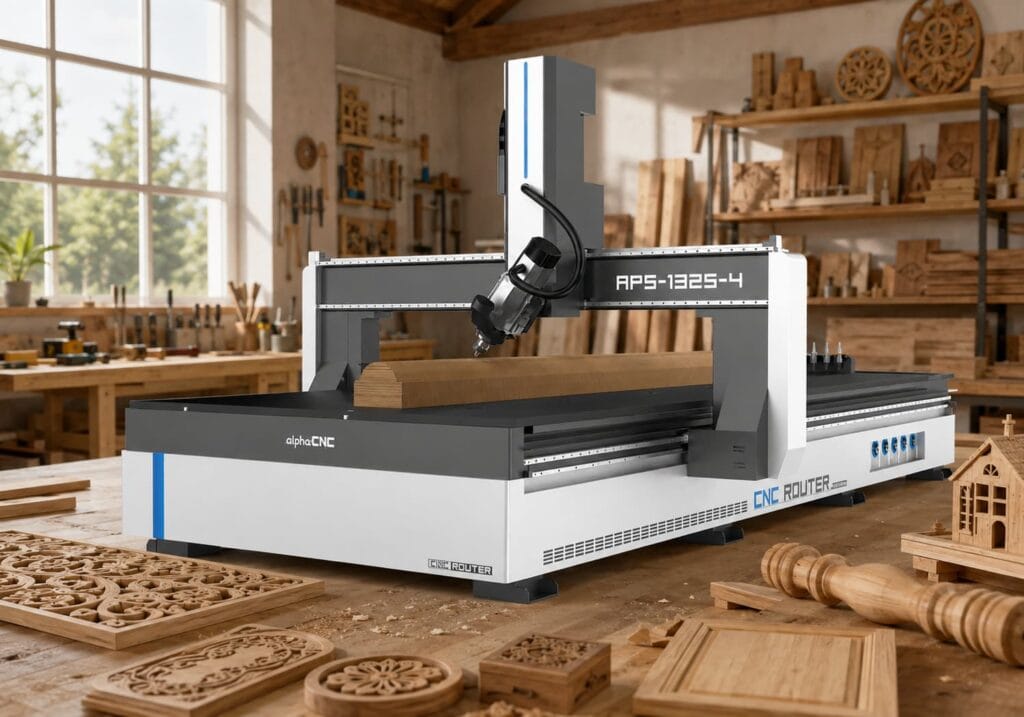
Depending on the machine configuration, tools, and materials being processed, a CNC router can cut, drill, groove, engrave, and perform 3D machining. This guide is based on Alpha CNC’s experience in CNC router manufacturing and applications. It covers CNC router functions, common processing materials, and applications to help you choose a CNC router that suits your needs.

1. What Can a CNC Router Do?
CNC Router Cutting
Cutting is one of the most common functions of a CNC router, mainly used to process a whole sheet of material into parts of the required size and shape. It can not only perform straight-line cutting, but also complete the cutting of curves, circles, and other complex contours according to preset machining paths.
CNC Router Engraving

By controlling the machining depth and movement path of the tool, a CNC router can process text, patterns, textures, and shallow reliefs on the material surface. According to different tools and design files, it can also process V-shaped text and decorative patterns.
CNC Router Drilling
A CNC router can complete drilling holes of different sizes and depths at specified positions on the workpiece according to the machining program. Common hole machining includes mounting holes, connection holes, positioning holes, and hardware holes.
CNC Router Grooving
By using suitable tools, a CNC router can process grooves of different widths and depths on the surface or edge of the material. For example, in furniture and cabinet processing, it can be used to process connection grooves, back panel grooves, and drawer grooves.

CNC Router Profiling
Profiling refers to machining the shape and edges of the part itself. For example, a CNC router can process the outer contours, inner contours, curved edges, chamfers, and irregular edges of workpieces.
CNC Router 3D Carving
By controlling the movement of multiple axes, a CNC router can process three-dimensional surfaces and three-dimensional patterns with different height and depth variations. However, the actual complexity of 3D machining that the machine can complete will also be affected by factors such as machine structure, number of axes, spindle performance, tools, and machining software.
2. What Materials Can a CNC Router Process?
Wood and engineered wood boards are the most common processing materials for CNC routers. A CNC router can handle acrylic, plastic sheets, and foam when configured properly.

CNC Router for Solid Wood
A CNC router is capable of routing many types of solid wood, including pine, oak, walnut, and cherry. Appropriate tooling and cutting parameters should be chosen for the material.
CNC Router for Engineered Wood Board
MDF and plywood are widely used materials in furniture and cabinet making. These boards can also be run through CNC routers to be cut and drilled.

CNC Router for Acrylic
A CNC router can process acrylic sheets for cutting letter shapes, machining contours, and making decorative patterns. A CNC router is more suitable for acrylic parts that require mechanical cutting, as well as some thicker acrylic sheets.

CNC Router for Plastic
Some CNC routers can also process plastic sheets such as PVC, PE, and ABS. Whether they can be processed and the processing results will be affected by factors such as the type of plastic, sheet thickness, tool, spindle speed, and feed rate.
CNC Router for Foam
Once the appropriate tools and machining parameters have been set, a CNC router can also be used to cut foam materials including EPS, XPS, and PU foam.

Other Materials
Some CNC machines can also process aluminum, brass, and certain stone or composite materials, but these materials have higher requirements for machine rigidity, spindle, tools, and cooling methods.
Not all CNC routers are able to work with these materials. When the material and processing requirements are provided, the machine configuration should be selected accordingly.
3. What Products Can a CNC Router Make?
The functions of a CNC router are not limited to processing individual parts. It can also be used to make furniture, cabinets, advertising signs, decorative products, models, and various custom wood products.
CNC Router for Furniture and Cabinet Parts

Furniture and cabinetry are the most typical uses of CNC routers. They are not only used to make kitchen cabinets and bathroom cabinets but also furniture and home products such as wardrobes, office tables, and coffee tables.
CNC Router for Advertising Signs

Signs of varying shapes and sizes can be made through cutting, engraving, and profiling. This makes CNC routers suitable for sign-making shops, advertising-production companies, and businesses that produce customized signage.
CNC Router for Decorative Panels and Interior Decoration Products
The same CNC router can produce different patterns and surface finishes by changing the tools and tool paths, making it suitable for customized decorative products.
CNC Router for Custom Wood Products and Crafts

For small woodworking shops and custom processing businesses, a CNC router can be used to make wooden maps, wall decorations, nameplates, wooden signs, crafts, and personalized gifts.
CNC Router for Models, Samples, and Sculptures
A CNC router can also process architectural models, product prototypes, foam models, and some sculptures. Especially when processing EPS and PU foam, a CNC router can be used to quickly complete complex contours and three-dimensional shapes. For model and sample production that requires repeated design modifications, this processing method is also relatively flexible.
4. Choose the Right CNC Router Based on Your Production Needs

A CNC router with more functions and more axes is not always the best choice. For many machining jobs, the working size, number of axes, spindle configuration, tool-changing system, and workpiece type will directly affect processing efficiency and the final equipment cost.
You can first determine what products you mainly process, and then choose the corresponding CNC router configuration. The Configuration depends on material, workpiece geometry, and production volume.
| Products / Workpieces | Main Processing Requirements | Recommended CNC Router | Key Factors to Confirm |
| Furniture panels, cabinets, shelves | Flat cutting, drilling, grooving, engraving | 3-Axis CNC Router | Workpiece size, material, production volume |
| Custom furniture with multiple processes | Multiple tools and continuous machining | CNC Router with ATC | Number of tools, tool-changing frequency, production volume |
| Wooden signs, acrylic letters, crafts | Cutting, engraving, profiling | Small 3-Axis CNC Router | Product size, material, available workspace |
| Table legs, wooden columns, cylindrical workpieces | Rotary surface machining | CNC Router with Rotary Axis | Workpiece diameter, length, and whether rotary machining is occasional or frequent |
| Curved furniture, inclined-surface parts, irregular workpieces | Machining surfaces that require different tool angles | 4-Axis CNC Router | Machine structure, tool angle requirements, workpiece geometry |
| Complex carvings, molds, multi-angle parts | Multi-angle and complex 3D machining | 5-Axis CNC Router | Number of machining directions, software, programming requirements |
Furniture and Cabinet Panels: 3-Axis CNC Router for Wood

If you mainly process cabinet doors, side panels, shelves, tabletops, and other flat furniture parts that can be machined from the top surface, a basic 3-Axis CNC router can usually meet the needs of cutting, drilling, grooving, engraving, and profiling.
For furniture factories or cabinet processing factories that need to process full sheets of material, the machine’s working size also needs to be considered. For instance, a 1325 CNC router is commonly associated with a working area of about 1300 × 2500 × 200mm, which is close to standard 4 × 8 ft sheet processing.
Needing to Use Multiple Tools: CNC Router with ATC
If a workpiece requires multiple machining processes and different tools, especially when these operations are repeated frequently, an ATC CNC router can be more efficient.

The ATC can change between different tools automatically according to the machining program, saving time on changing tools manually and doing repetitive jobs. Therefore, it is more suitable for furniture, cabinets, and custom woodworking products with more processing procedures or that require continuous batch production.
If you only occasionally process simple parts, manual tool changing may be enough for you. However, as the number of product processes increases or production volume increases, ATC can help reduce manual operations during the machining process.
Signs, Crafts, and Small Custom Products: Small CNC Router
If you mainly produce wooden signs, acrylic letters, logos, medals, souvenirs, wooden crafts, or other small-sized custom products, you can choose a CNC router with a relatively small working area, such as a 6090 CNC router. These types of machines occupy relatively little space and are more suitable for workshops, advertising processing factories, and small custom processing businesses.

Keep in mind that a smaller machine is not always better. It is better to reserve a certain amount of processing space according to the maximum size of your products to avoid limiting product production later due to insufficient working area.
Table Legs and Cylindrical Products: Rotary Axis CNC Router
If you need to machine table legs, wooden columns, stair handrails, cylindrical decorative parts, or other rotary workpieces, a standard 3-Axis CNC router may not be the most suitable configuration.

These types of products usually require a rotary axis. A rotary axis rotates the cylindrical workpiece during machining, allowing the CNC router to machine characters, patterns, textures, and certain shapes on its surface. The actual machining capabilities depend on the rotary axis configuration, workpiece size range, and software support.

Therefore, before purchasing a machine, you need to first confirm whether you need to process cylindrical or regular rotary products. If these types of products are only processed occasionally, you can also choose a CNC router with an optional Rotary Axis according to your actual needs.
Curved and Inclined Parts: 4-Axis CNC Router
If the product has inclined surfaces, curved surfaces, side surfaces, or other structures that require changes in the tool cutting angle during machining, in addition to normal flat machining, you can also use a 4-Axis CNC router.

For example, some curved furniture components, inclined-surface parts, decorative components, and complex door panels may require more tool-angle flexibility than a standard 3-Axis CNC router can provide.
It should be noted that 4-Axis CNC routers on the market have different structures, such as swivel-head 4-axis and 4-axis with a rotary axis. Therefore, when choosing a machine, you should not evaluate a machine based only on the “4-Axis” parameter, but need to confirm whether the specific structure of the machine is suitable for your products.
Complex 3D Products and Multi-Angle Parts: 5-Axis CNC Router
If your products have complex 3D surfaces, multiple machining directions, or geometries that require the tool orientation to change during machining, a 5-Axis CNC router can provide greater machining flexibility.

A 5-Axis CNC router allows coordinated movement across multiple axes, giving the tool greater freedom to approach complex three-dimensional surfaces and multi-angle structures.
The price of a 5-Axis CNC router is also higher, and the required software may be more advanced, while the programming process may be more complex. So if your product is mostly furniture panels, cabinets, or ordinary woodworking parts, a 5-Axis CNC router may not be worth the additional cost.
FAQ
Can a CNC Router Complete Multiple Processes in One Machining Operation?
A CNC router can complete multiple machining processes in one setup, but the specific number of processes that can be completed depends on the machine configuration. A basic 3-Axis CNC router can perform cutting, engraving, drilling, and grooving, but different tools usually need to be changed manually. If an ATC automatic tool changing system is configured, the machine can automatically switch between different tools according to the machining program and continuously complete multiple machining steps.
Which CNC Router Functions Can Improve Production Efficiency?
The really useful functions of a CNC router are the ones that minimize tool changes, workpiece setups, and manual operations, or allow you to handle more workpiece types. For instance, if a workpiece requires several tools for processing, the ATC system could minimize the time for changing tools by hand; if the product is composed of curves or multi-angle structures, you can pick a 4-Axis or 5-Axis setup.
So you should not just blindly go for a machine with the most features, but select a configuration that is really needed based on the type of products, machining processes, and the volume of production.
Is a Basic 3-Axis CNC Router Suitable for Processing Small Furniture and Cabinets?
A 3-Axis CNC router is suitable for most conventional sheet material processing and can be used to process small furniture and cabinets. The materials that this type of CNC machine can process are usually MDF, plywood, and solid wood. The products typically include cabinet doors, side panels, shelves, and basic furniture parts.
What CNC Router Configurations Should be Considered When it is Only Used for Cutting and Engraving Wood?
The working area of your CNC machine needs to cover the size of your largest workpiece. The spindle speed and feed rate need to be adjusted based on the type and thickness of the wood, as well as the tool and spindle used.
If you mainly process full sheets of material, choosing a vacuum table can better fix the workpiece. The guide rails, transmission system, and control system will also affect the stability and repeat machining performance during long-term processing. In addition, the expected production volume also needs to be considered.
Can the Same CNC Machine be Used to Cut Wood and Acrylic?
The same CNC machine can be used to cut wood and acrylic, but the two materials require different tools and machining parameters. During actual machining, you should refer to the recommended parameters provided by the tool supplier and conduct tests according to the specific material.
Final Thoughts

After understanding the capabilities of CNC routers, it is more important to choose a machine that truly meets your processing needs and budget. Alpha CNC provides CNC machines with various configurations and functions to meet the processing needs of different materials, products, and production scales.
Tell us the materials, product types, maximum workpiece size and thickness, and expected daily or monthly production volume. If needed, you can also share your required machining processes or tool-changing needs. We can recommend a suitable machine configuration and prepare a quotation based on your requirements.


