
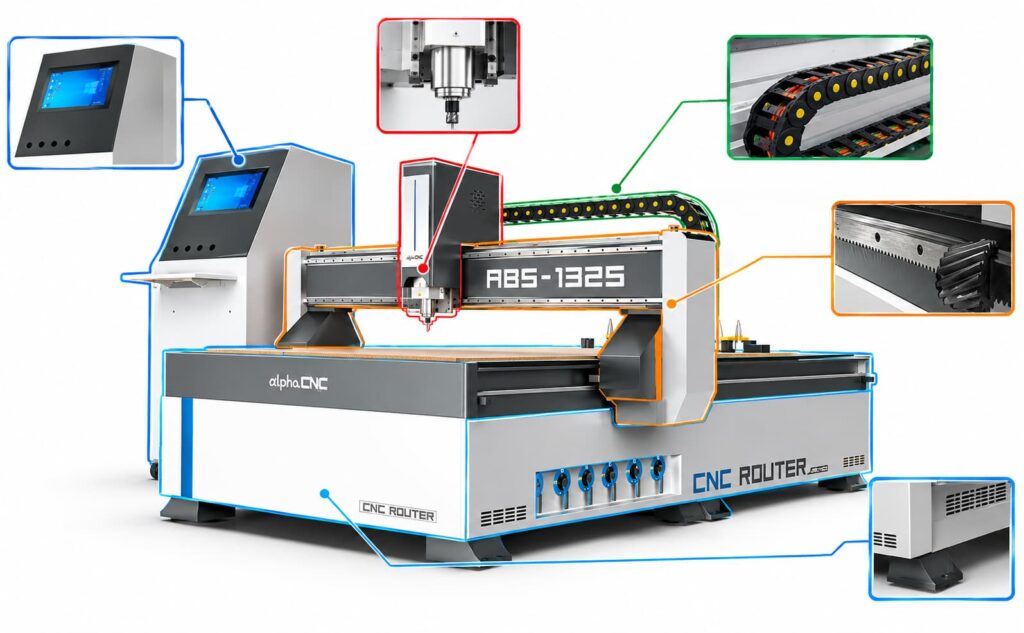
When comparing CNC routers, many people generally focus on the working area, spindle power, and machine price. However, the performance of a machine is determined by different CNC router parts. The main CNC router components include the frame, spindle system, motion system, drive system, control system, electrical system, and worktable. These CNC router components affect the machining accuracy, operating stability, and production efficiency. Knowing the basics of CNC router parts can help you select the CNC configuration that best suits your needs.
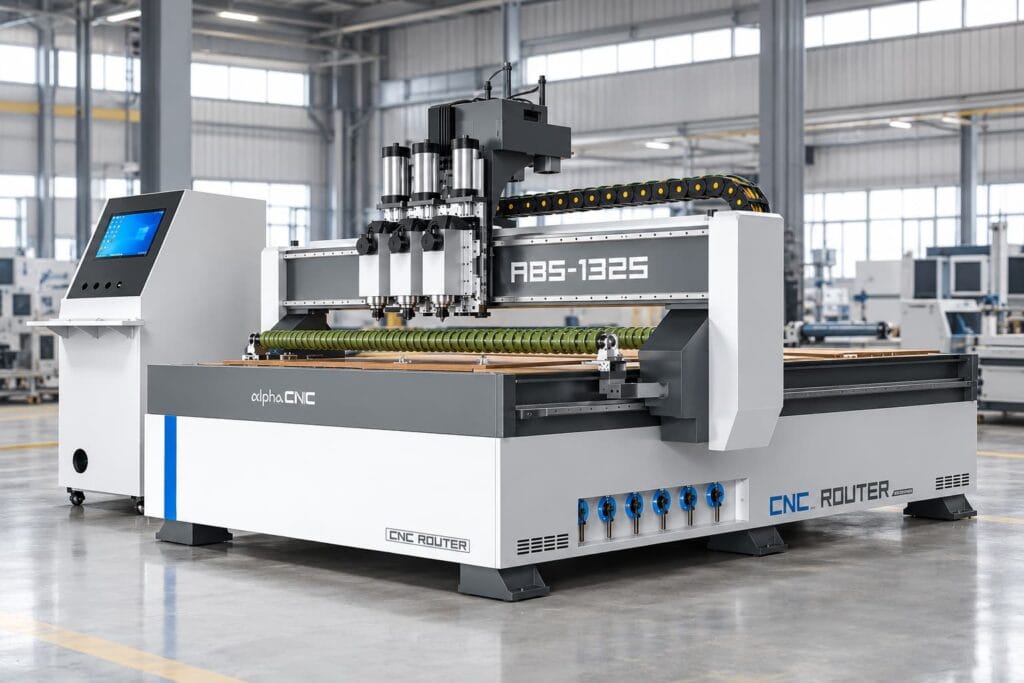
CNC Router Components Overview
Here are the main parts of a CNC router:
| CNC Router Components | Main Parts/Types | Function |
| Machine Frame | Machine Body, Base, Gantry, Side Supports | Provide support and stability, affecting the rigidity of the machine. |
| Spindle System | Spindle Motor, Tool Holder, Collet | Drives the tool to rotate, enabling cutting, carving, and drilling. |
| Motion System | Linear Guide Rails, Gear Racks, Ball Screws | Control movement along the X, Y, and Z axes for precise positioning. |
| Drive System | Stepper Motors, Servo Motors, Hybrid Servo Motors, Drivers | Provide power for each motion axis. |
| Control System | NC Studio, Syntec, LNC, Mach 3, DSP | Execute G-code and coordinate the operation of the machine’s components. |
| Electrical System | Electrical Control Cabinet, Transformer, Power Supply, Driver, Electrical Components and Circuits | Provide power and control signals while protecting electrical components. |
| Worktable | Vacuum Table, T-Slot Table | Support and fix the processing materials. |
1. CNC Router Frame
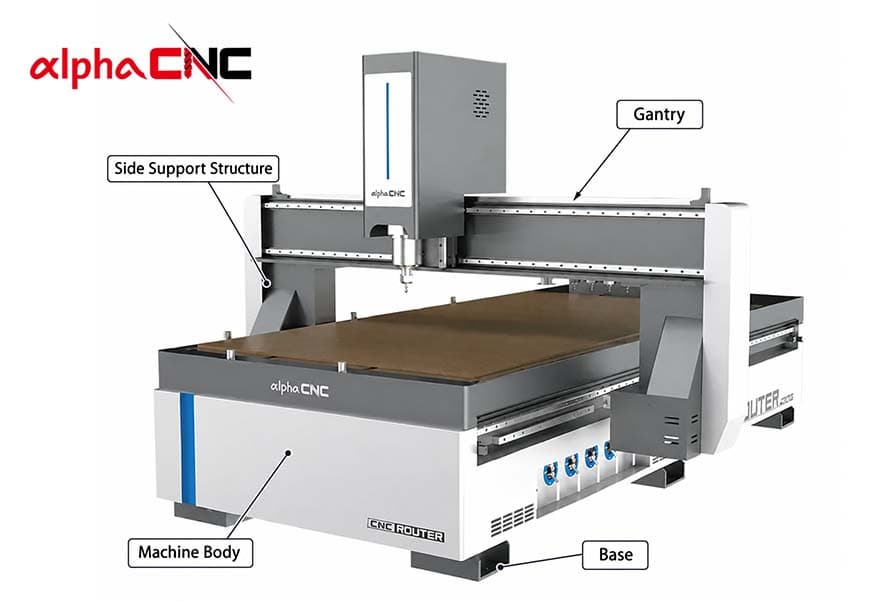
The CNC router frame is the skeleton of the CNC machine. It is one of the most important CNC router components. It is mainly composed of the machine body, base, gantry, and the associated support structures.
The machine body and base of the CNC router are the main load-bearing structures of the entire equipment, and they need to bear the weight of components such as the spindle system, transmission system, and workpieces.
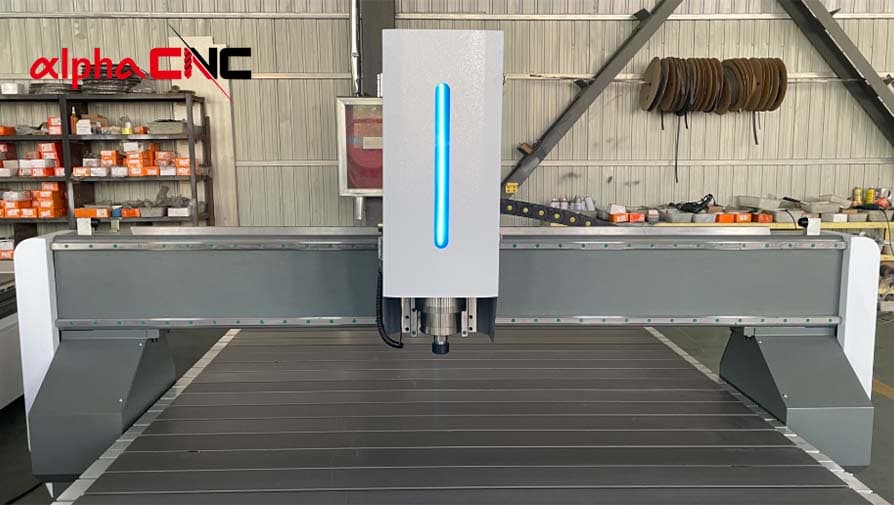
The gantry of the CNC router is a bridge structure that spans above the working area, mainly used to support the X-axis motion components and spindle system. By working together with the guide rails and transmission system, the spindle can move in the X and Y directions within the working area. The structural rigidity and stability of the gantry will affect vibration, positioning accuracy, and long-term machining stability of the machine during high-speed movement and cutting processes.
2. CNC Router Spindle System
The CNC router spindle system is one of the most important components of a CNC machine. A complete spindle system usually includes the spindle motor, tool holder, collet, and cooling system.
The CNC router spindle is responsible for driving the CNC router bit to rotate at high speed and is the core power component for a CNC router to complete cutting operations. According to the cooling method, spindles can be divided into air-cooled spindles and water-cooled spindles. Air-cooled spindles dissipate heat through a fan, have a relatively simple structure, and are relatively convenient to install and maintain. They are suitable for processing materials such as wood, MDF, plastic, and acrylic. Water-cooled spindles dissipate heat through water circulation and are suitable for metal processing or CNC machines that need to operate continuously for a long time.
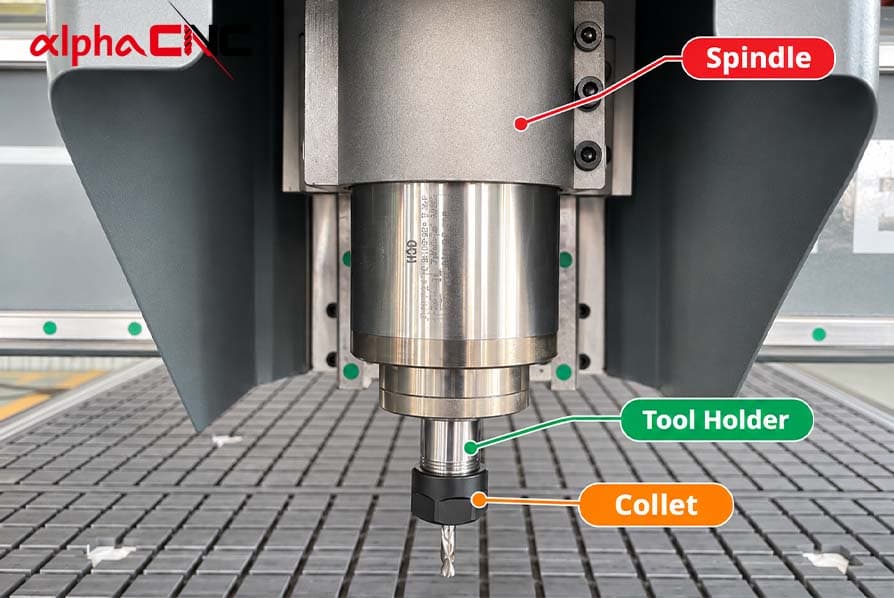
The CNC router tool holder is used to install the tool and connect the tool to the spindle. The tool holder needs to match the specifications of the spindle and tool. For an ATC CNC router, the tool holder also needs to match the clamping method of the tool magazine.
The CNC router collet is installed inside the tool holder and can fix the tool in the tool holder. There are different types of collets for clamping tool shanks of various sizes. When using, it is necessary to choose the appropriate collet according to the diameter of the tool shank. The selection of the right collet will improve tool clamping stability and minimize tool runout during machining.
3. CNC Control System
The CNC control system is responsible for receiving and executing machining instructions and coordinating the axes and spindle of the CNC router to complete machining.
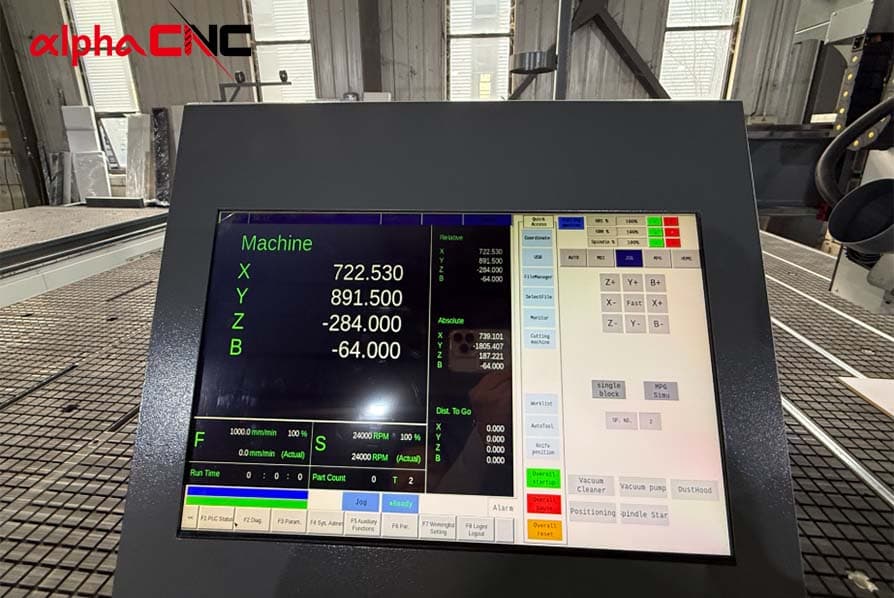
CAM software generates tool paths and machining instructions, which are commonly output as G-code and then interpreted by the CNC control system. After the CNC control system reads the machining program, it processes the instructions and controls the X, Y, and Z axes and spindle to run according to the set machining path.
Common CNC router control systems include:
- DSP Controller
- NC Studio
- Syntec
- LNC
- Mach3
Different control systems may differ in terms of operation methods, supported number of axes, automatic tool changing, multi-axis machining, and functional configurations.
For machines without automatic tool changing, a relatively cost-effective control system is usually sufficient. If you want the CNC router to be connected to a computer while working, we recommend the Mach3 system. If you want the CNC router to work without being connected to a computer, we recommend the DSP system.
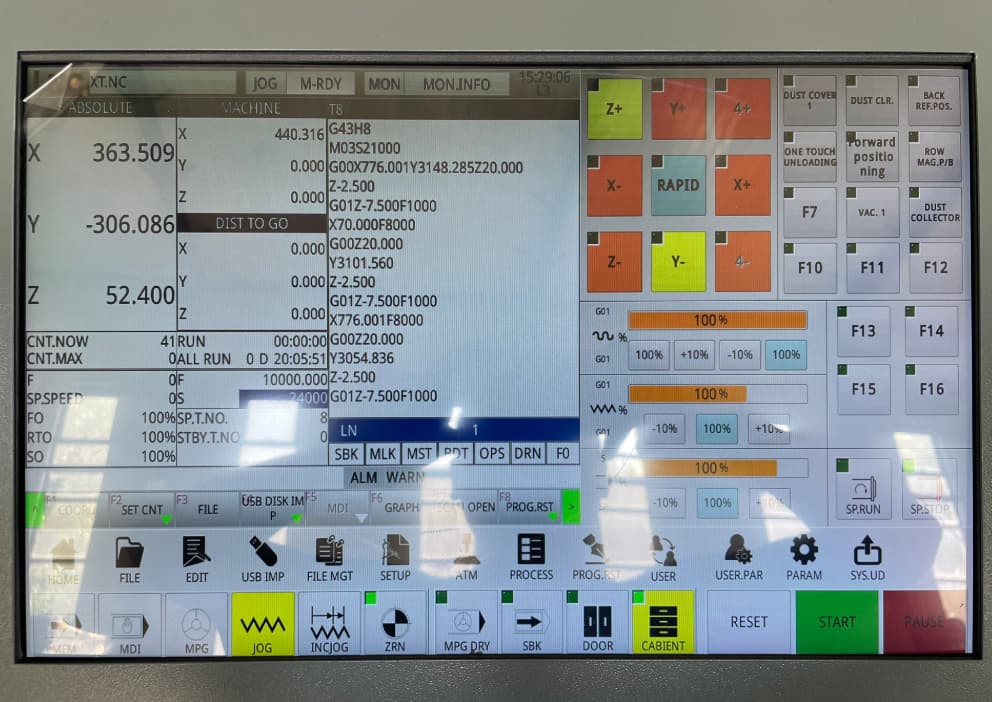
For machines with automatic tool changing, we recommend using an industrial-grade control system. Especially for machines used in the custom furniture industry, we recommend the LNC or Syntec control system. These two systems have been optimized in terms of parameters for the furniture manufacturing industry, making them more convenient to use.
4. CNC Router Motion System
The motion system of a CNC router is responsible for moving and transmitting motion to each axis. It mainly includes linear guide rails, rack and pinion transmission, and ball screw transmission. These CNC components are important CNC hardware parts that determine how the machine moves and positions the cutting tool.
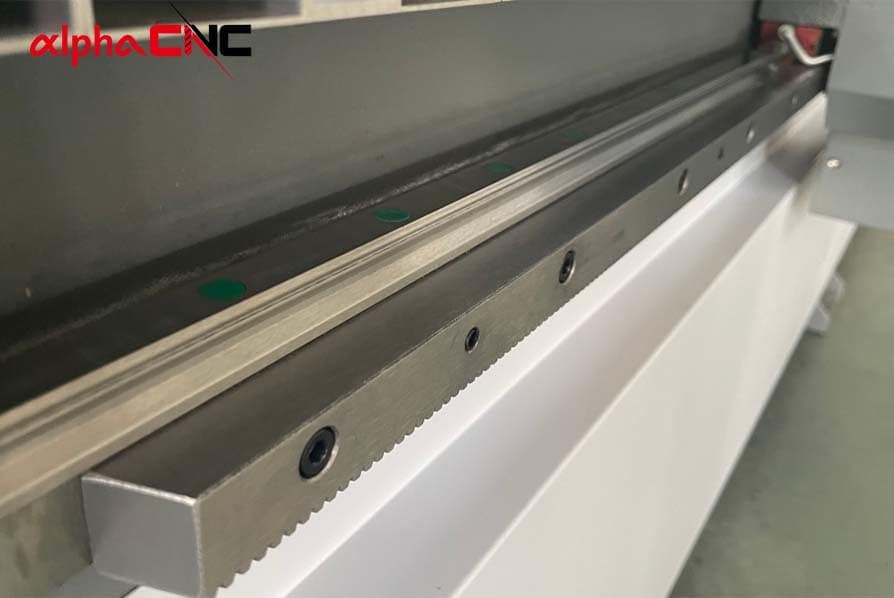
The linear guide rail offers X, Y, and Z axis movement guidance, allowing each axis to move in the given direction smoothly. They are usually used together with sliders to provide stable tracks for moving components such as the gantry and spindle. If the guide rails are not installed evenly or do not have sufficient accuracy, problems such as shaking and deviation may occur during movement, which can affect machining accuracy.
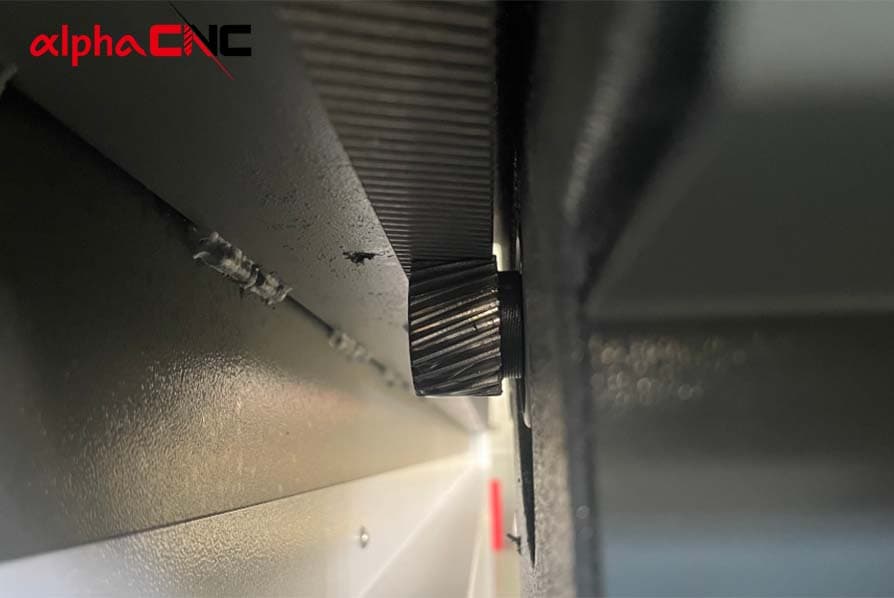
Rack and pinion is a common linear transmission method used to drive the moving components of a CNC router. For the CNC woodworking industry, CNC router sizes of 1325 (4×8 ft) and above generally use rack and pinion for the X and Y axis drive.
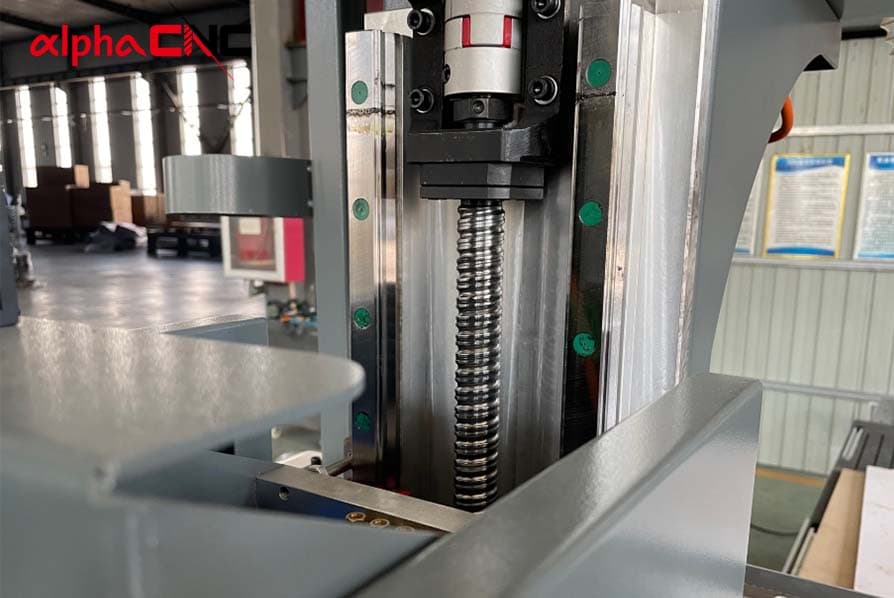
A ball screw is a kind of linear motion transmission element. Ball screws can reduce friction and make movement smoother than ordinary screws and enable higher positioning accuracy. They also provide a consistent cutting depth. For small-sized machines or machines that require high precision, a screw drive system is used.
5. CNC Drive System
The CNC router drive system is responsible for driving the X, Y, and Z axes and other moving parts to complete movement according to the instructions issued by the CNC control system. It mainly consists of motors and drivers. The common motor types used in CNC routers mainly include:
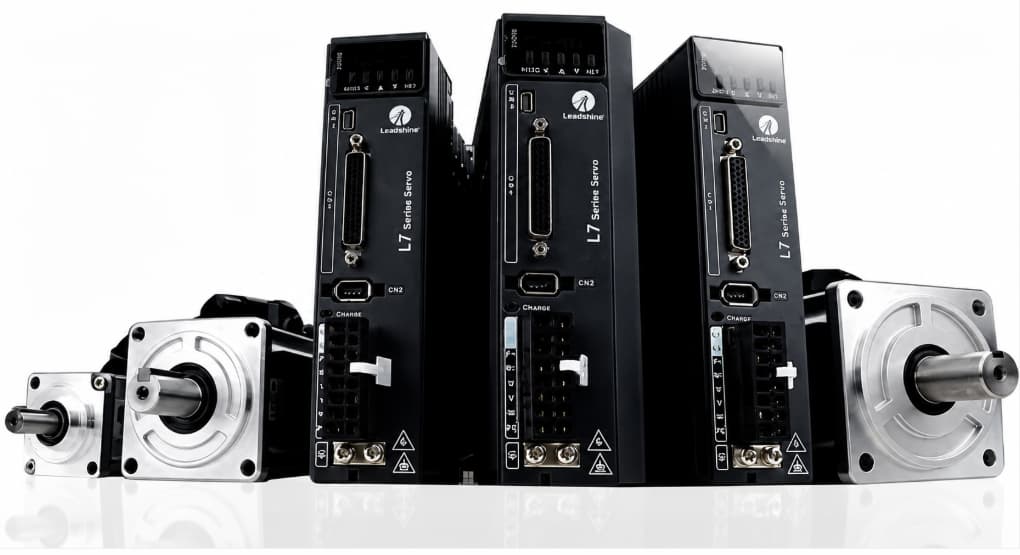
- Servo Motor: Usually equipped with an encoder, which can provide feedback on the motor’s position and operating status. CNC Servo motors are mainly used in industries that have relatively high requirements for machine accuracy and efficiency, such as the custom furniture production and manufacturing industry.
- Stepper Motor: Controls the motor movement through pulse signals, with a relatively simple structure and lower cost. CNC stepper motors are mainly used in machines that do not have high requirements for machine accuracy, such as machines without automatic tool changers.
- Hybrid Servo Motor: Uses a stepper motor structure combined with an encoder and closed-loop control, adding motion feedback functionality based on the stepper motor. However, as the price of Chinese servo motors has decreased, hybrid servo stepper motors no longer have a price advantage and are expected to be gradually phased out in the future.
6. CNC Router Electrical System
The electrical system is responsible for providing power to the electrical parts of the CNC router and completing the electrical connections and signal control between the components.

It mainly includes:
- Electrical Cabinet: Used for mounting electrical components such as inverters, drivers, power supplies, and relays.
- Inverter: Mainly used to control the spindle speed.
- Motor Drivers: Receive signals from the control system.
- Relays: Control the start and stop of auxiliary equipment such as water pumps and fans according to control signals.
- Electrical Wiring: Responsible for transmitting power and control signals.
7. CNC Router Working Table
The worktable is one of the essential parts for a CNC router. It is used to support and secure workpieces. Common types include vacuum tables and T-slot tables.
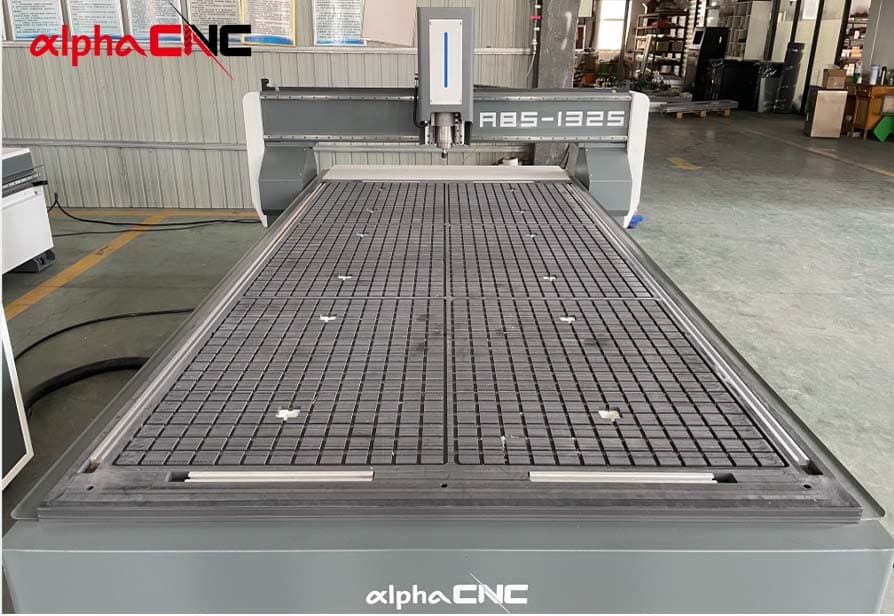
The CNC router vacuum table generates negative pressure through a vacuum pump to hold the workpiece onto the surface of the worktable. It can reduce manual clamping and positioning operations and improve the efficiency of loading and unloading panels and continuous machining. Vacuum tables are suitable for processing flat materials such as MDF, plywood, and furniture panels.
The T-slot table holds the workpieces with mechanical methods such as clamps and hold-down plates. This is much more flexible; you can move the clamps to suit the shape of the workpiece. It is suitable for processing thicker and irregularly shaped workpieces.
8. Other CNC Router Accessories and Configurations
In addition to the main CNC router parts listed above, you can also add corresponding CNC router accessories according to your machining needs.
Dust Collection System
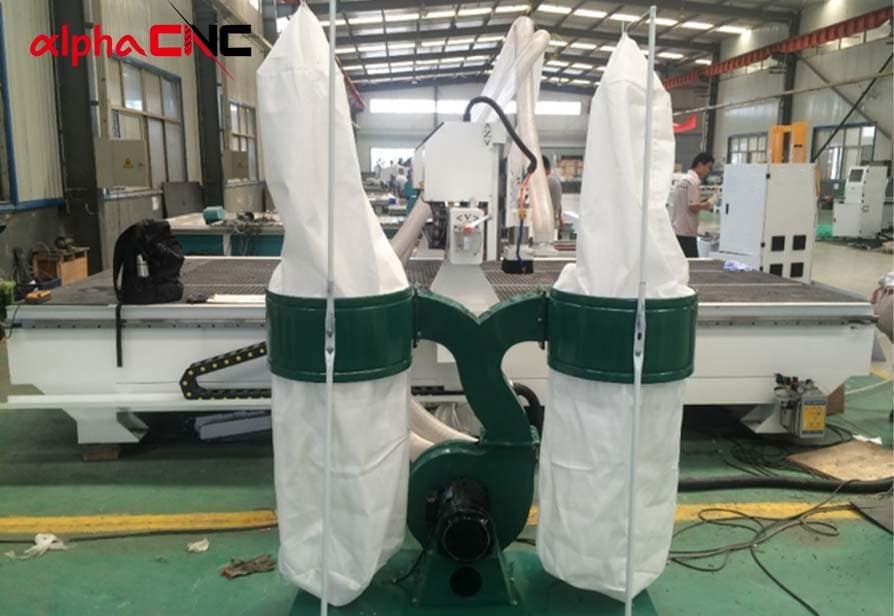
The dust collection system is mainly used to collect wood chips and dust generated during the machining process. For CNC routers mainly used for processing wood, we strongly recommend equipping them with a dust collection system.
Automatic Tool Changer
When a machining program needs to use multiple different tools, the ATC can automatically complete tool changes according to the program. An ATC CNC router is more suitable for production environments with multiple tools, multiple processes, and continuous machining. It can reduce tool-changing time and manual operations, making the machining process more continuous. For panel furniture manufacturing, the automatic tool-changing function is essential.
Rotary Axis
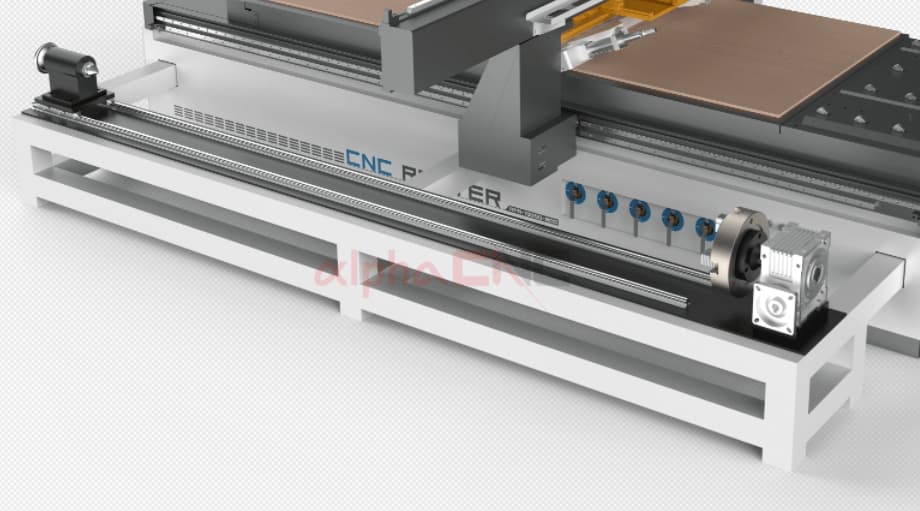
The rotary axis is mainly used for machining cylindrical workpieces. It allows the workpiece to rotate during the machining process, enabling the tool to machine surfaces of the workpiece in different directions. A CNC router with a rotary axis can not only process ordinary flat panels, but can also be used to process wooden columns, table legs, chair legs, stair handrails, and other cylindrical decorative parts.
Multi-Spindle
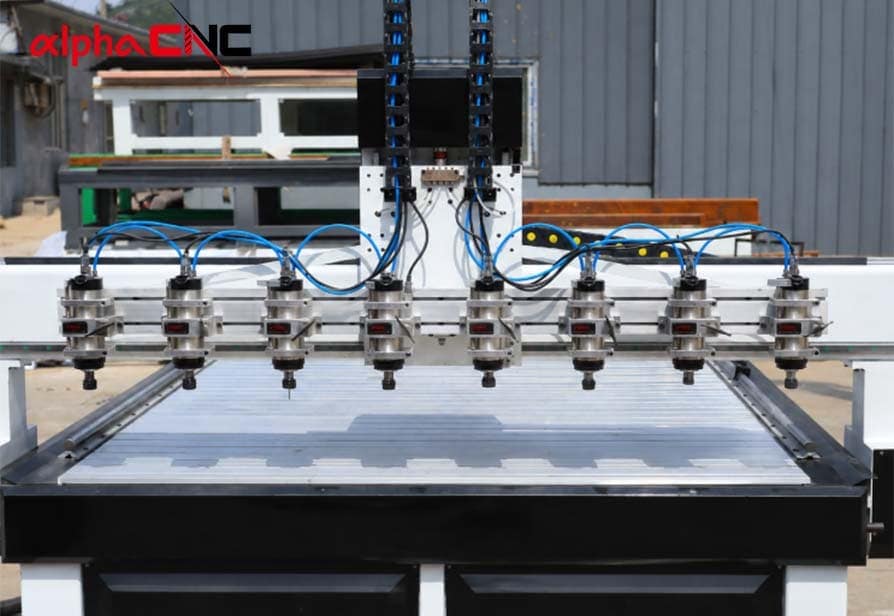
A CNC router can be equipped with multiple spindles to improve the efficiency of repetitive machining. Multi-spindle CNC routers are more suitable for production scenarios involving batch processing of identical or similar parts.
9. CNC Router Components for Different Applications
CNC Router for Furniture Manufacturing
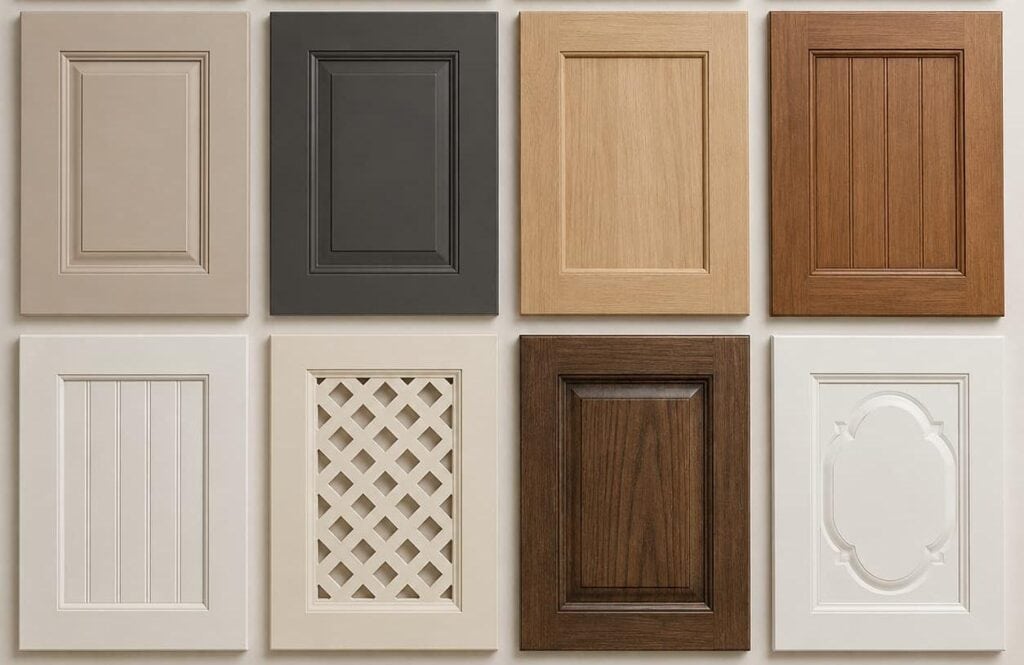
In furniture manufacturing, a CNC router is widely used for processing MDF, plywood, particle board, solid wood, and so on. Typical operations are panel cutting, slotting, drilling, and pocketing. For products such as cabinets, wardrobes, kitchen cabinets, and furniture door panels, the machine usually needs to process full-size panels and complete multiple processes in one machining operation.
Suitable configuration: 1325/1530 working area + suitable spindle + vacuum table + ATC + dust collection.
Recommended machine: 1325 ATC CNC Router
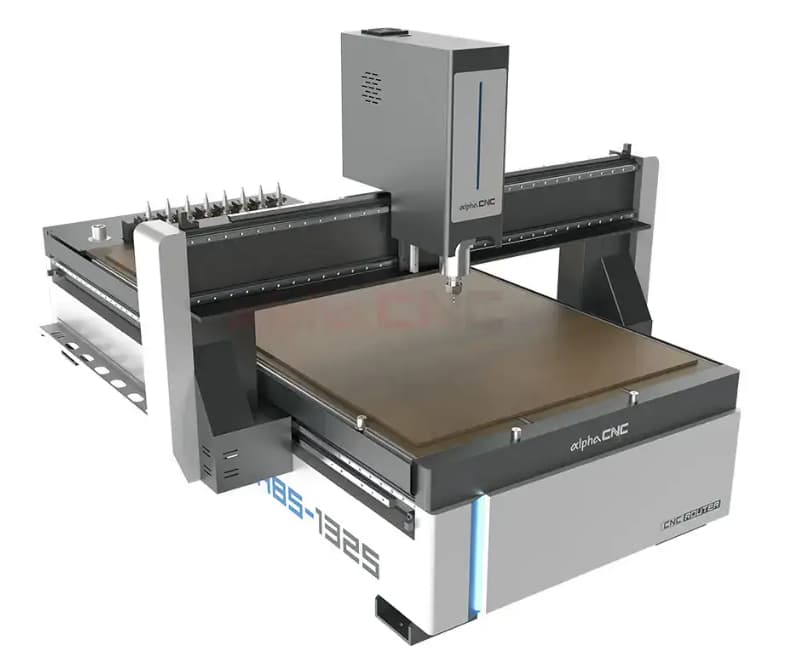
A 1325 ATC CNC router can handle standard 4×8 ft panels, and the ATC system can automatically change tools for different processes, such as cutting, slotting, and drilling, which reduces manual downtime for tool changes. When connected to a vacuum table, the full-size panel can be held directly by vacuum suction, which is more suitable for continuous machining.
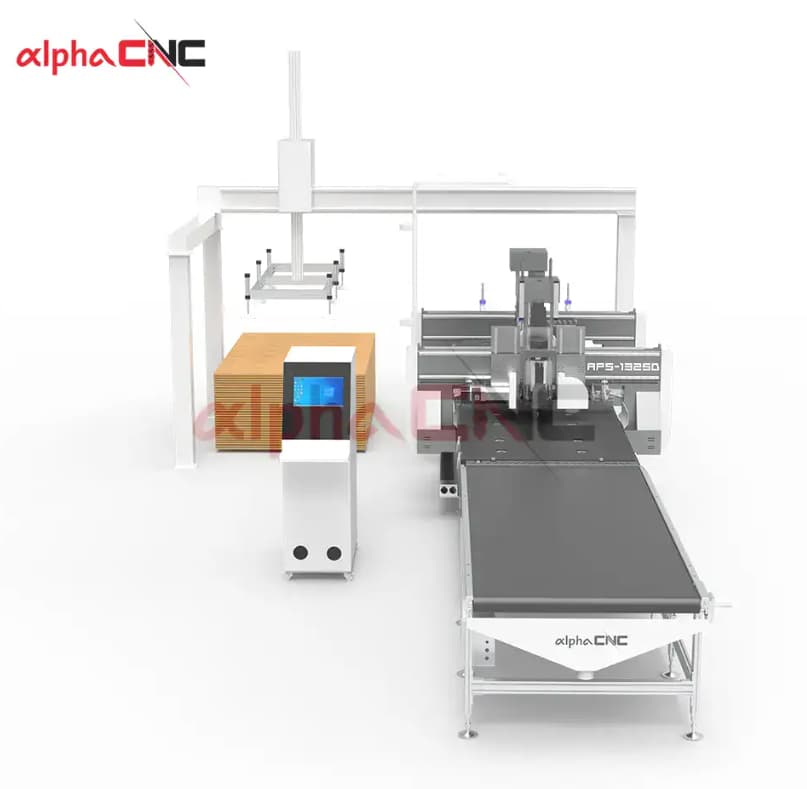
Besides, if you want to improve production efficiency and reduce labor requirements, optional features such as automatic loading and unloading, automatic labeling, and line drilling can further reduce manual handling. You can also consider the 1325 ATC industrial CNC router for furniture.
CNC Router for Advertising Sign Production

Advertising sign processing usually involves different materials such as acrylic, PVC, and foam board. Common processes include cutting, slotting, text engraving, and pattern engraving. The workpiece sizes and materials used in advertising processing vary widely, but many products still involve flat-surface processing, so complex multi-axis configurations are not necessarily required.
Suitable configuration: 3-axis CNC router + suitable spindle + vacuum table or T-slot table + dust collection
Recommended machine: 1325 3-Axis CNC Router
The 1325 3-axis CNC router is a practical choice for advertising sign processing. A machining area of approximately 1300×2500 mm can cover common large-size advertising panels, while the 3-axis structure can already complete most flat cutting, text engraving, and pattern processing. If the material size is small and the shape is irregular, a T-slot table with clamps will be more suitable for securing the workpiece.
CNC Router for 3D Wood Carving
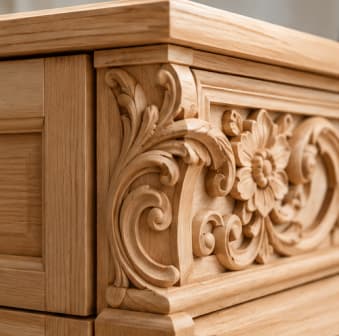
3D wood carving is usually used to make furniture decorative parts, reliefs, three-dimensional sculptures, architectural decorative parts, and wooden products with complex curved surfaces and three-dimensional structures. Compared with ordinary flat engraving, this type of machining requires controlling different machining depths and tool paths, so the appropriate number of axes should be selected according to the complexity of the workpiece’s curved surfaces.
Suitable configuration: Multi-axis CNC router + ATC + suitable spindle + T-slot table or vacuum table
Recommended machine: 1325 4-axis ATC CNC router
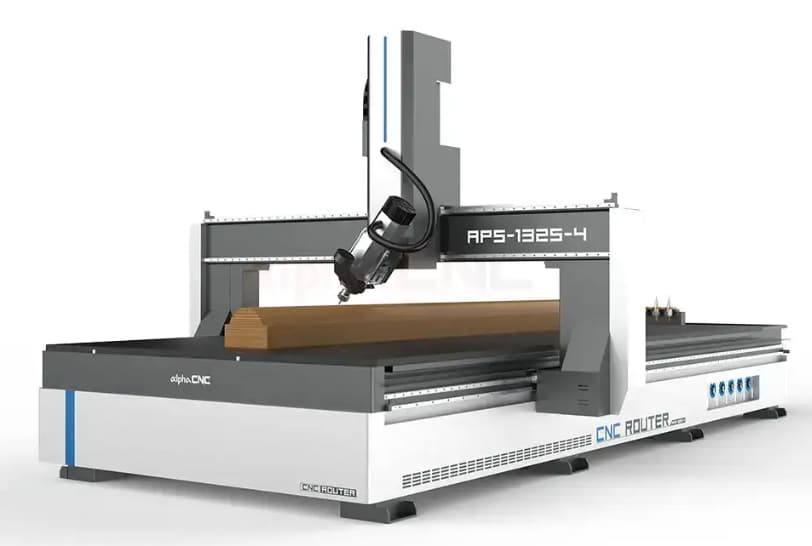
A 3-axis CNC router can meet some 3D relief machining requirements. For workpieces that need to be machined on their sides or inclined surfaces, or from multiple directions, the 4-axis ATC CNC router is more suitable. The ATC can automatically change tools between different processes such as rough machining and finishing, making it more suitable for wood carving that requires multiple tools to complete.
CNC Router for Cylindrical Workpieces
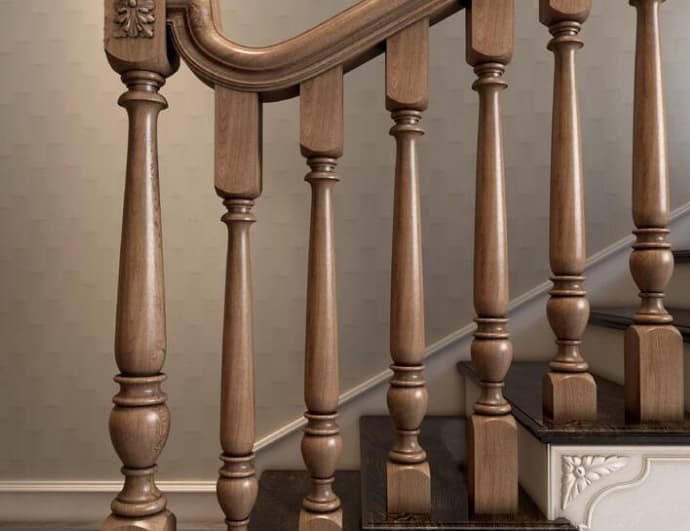
Rotary woodworking is mainly used for processing cylindrical and other rotary workpieces, such as table legs, chair legs, stair balusters, wooden columns, and other cylindrical and rotary workpieces. When processing these types of workpieces, the machine needs to have suitable rotary machining capabilities for cylindrical workpieces.
Suitable configuration: Rotary Axis + suitable spindle + suitable workholding system
Recommended machine: Rotary Axis CNC Router
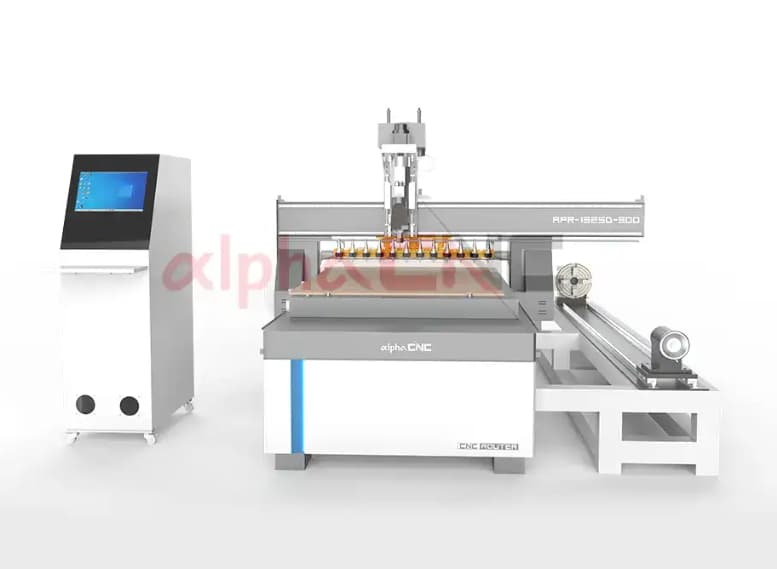
The rotary axis CNC router is equipped with a rotary axis, which can drive cylindrical wooden workpieces to rotate during the machining process, allowing the spindle to machine surfaces in different directions of the workpiece. Through this machining method, textures, reliefs, slots, and 3D patterns can be machined on cylindrical surfaces.
FAQ
Which CNC Router Parts Need Regular Maintenance?
Linear guide rails, rack and pinion, ball screws, the spindle, and the electrical system need to be regularly inspected and maintained. Guide rails, racks, and ball screws need to be kept clean and lubricated as needed to prevent dust and wood chips from affecting movement; the spindle needs attention to cooling, lubrication, and abnormal noise; the electrical system should be regularly checked for the condition of the wiring, wiring terminals, and dust inside the electrical cabinet. The specific maintenance interval also needs to be adjusted according to the machine’s usage frequency and machining environment.
Which CNC Router Components Have the Greatest Impact on Machining Quality?
The machine body, motion system, and spindle system have a relatively large impact on machining quality. The machine body affects the overall stability of the machine during machining, the motion system affects the movement and positioning of each axis, and the spindle system directly affects the cutting performance of the tool and the quality of the machined surface.
Can CNC Router Components Be Upgraded Later?
Some configurations can be upgraded later, such as an automatic tool changing system, rotary axis, and dust collection system. However, core structures such as the machine body, machining range, and motion system usually need to be determined when purchasing the machine. Therefore, it is recommended to determine the main configurations in advance according to future machining needs.
How to Choose the Right CNC Router Configuration?
The configuration should be selected according to the material, workpiece size, and machining method. For example, panel processing requires consideration of a suitable machining range and worktable; for multi-process machining, you can choose an automatic tool changing system; cylindrical workpieces may require a rotary axis; and complex 3D machining requires selecting the appropriate number of axes according to the workpiece structure.
Do Different CNC Router Components Need to Match Each Other?
Yes. The machine body, spindle, motion system, drive system, and control system of a CNC router need to be reasonably matched according to the machine’s machining range, materials, and machining requirements.
Final Thoughts

Knowing the basic parts of a CNC router will also help you understand how the various machine styles that you see for sale differ, and why one might be more suitable for your needs than another.
If you have already decided which machine configuration you need, you can also send Alpha CNC your detailed requirements, and we can check further whether the configuration is suitable. If you still don’t know which CNC router you should choose, you can also tell us the material to be processed, the type of products you make, and the size of the workpiece; we can recommend a suitable machine configuration for you according to the actual requirements.


